How to Remove a Starter at a Junkyard: A 9-Step Pull
A starter looks like the same job as an alternator until you are lying under the car working a bolt you cannot see. Here is how the pull actually goes, and the one wiring mistake that can weld a wrench to a battery.
Key Takeaways
- Plan on 45 to 90 minutes for a first starter pull, versus 30 to 60 minutes for an alternator. The bolts are usually reached from underneath and at least one is blind.
- Disconnect the negative battery terminal first, every time. The heavy cable on the solenoid is unfused and tied straight to battery positive.
- Bring a long extension and a swivel or wobble socket. The alternator job does not need them; the starter job usually will not happen without them.
- Keep any shims that fall out. Wrong shimming on the platforms that use them produces a loud gear whine on every start.
Why a starter takes longer than an alternator
A starter pull runs 45 to 90 minutes for a first-timer, roughly half again as long as the 30 to 60 minutes pulling an alternator takes, and the reason is access rather than difficulty. An alternator sits high on the front of the engine where you can see both bolts and ratchet them standing up. A starter sits low on the bellhousing, which on most cars means working from below with the bolts pointed away from you.
At least one mounting bolt is normally blind. You find it by feel and seat the socket by feel. Rounding a bolt head you cannot see is how a 50-minute job becomes a two-hour job.
Confirming the donor starter matches your car
Match the engine code before you touch a bolt. Digit 8 of the VIN is the engine code on most domestic and Asian cars, and starters differ between engines offered in the same model year of the same car. On some platforms they also differ between manual and automatic, because the flywheel and ring gear differ. A starter that bolts up but meshes wrong will grind on the first crank.
Read the VIN off the donor's door jamb and decode it with our VIN lookup tool, then compare it against your own car. Where a model spans several engines, an interchange number is the faster check — the Hollander interchange guide covers how to read one. Photograph the casting numbers and connector layout before you leave the car.
Tools you need beyond the alternator kit
A socket set covering 8mm through 19mm handles about 90% of fasteners in a yard, and starter bolts sit in that range. Assume the standard kit from our list of tools to bring on a salvage yard run is already in the bag. What this job adds over the alternator job is reach and angle.
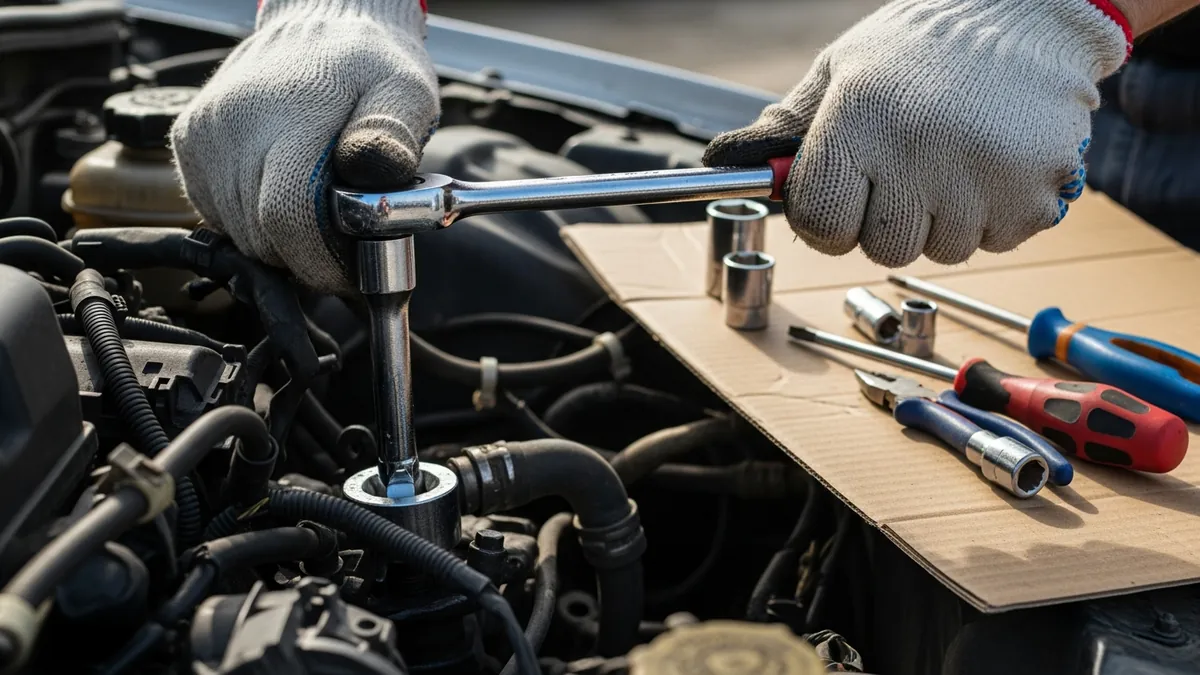
- Long extension — 10 to 18 inches, to reach a bellhousing bolt from outside the wheel well or behind the crossmember.
- Swivel or wobble socket — lets the extension come in off-axis, which is how most blind starter bolts must be approached.
- Penetrating oil — starter bolts sit low, catch road salt, and seize more often than anything on top of the engine.
- Combination wrenches — solenoid nuts are usually 8mm, 10mm, or 13mm, with rarely room for a socket.
- Headlamp and a scrap of cardboard — you will be on your back under a lifted car with dirt falling into your face.
Bring a bucket or canvas bag too. Starters weigh noticeably more than alternators, and hauling one plus tools across gravel by hand is how sockets get lost.
Two safety rules that are not optional
Disconnect the negative battery terminal before you go near the starter, and never get under a car supported by a jack alone. Both failure modes are severe rather than inconvenient.
The heavy cable bolted to the starter solenoid runs directly to the battery positive post, unfused. If your wrench on that stud touches the block, the frame, or the exhaust at the same time, the battery dumps several hundred amps through the tool and it welds itself to the car, glowing, in about a second. Pulling the negative terminal first breaks the loop and makes the whole job inert.
For lifting: rated jack stands only, never a jack alone. Most self-service yards pre-lift their cars and ban customer jacks outright. If the car you want is flat on the ground and you cannot reach the starter from above, pick a different car. Do not improvise with wheels, rims, or wood.
How to remove a starter at a junkyard
Run these in order. Identity first, battery second, and nothing touches the solenoid until the negative terminal is off.
- Confirm the donor. Check VIN digit 8 for the engine code and confirm manual versus automatic, then verify the starter is physically the same shape and connector layout as yours.
- Disconnect the negative battery terminal. Pull the clamp off the post and tuck it aside so it cannot spring back. If the donor has no battery, confirm that by looking.
- Spray the mounting bolts. Soak both heads and threads with penetrating oil, then wait a full 10 minutes. Pull something else off the same car while it works.
- Locate the bolts and set up your reach. Starters mount with two or three bolts into the bellhousing. Find each by hand and decide which needs the swivel and long extension.
- Remove the wiring. Small trigger wire off the S terminal first, then the nut holding the heavy positive cable to the solenoid. Let that cable hang clear of the starter.
- Break both bolts loose while the starter is still mounted. Crack each a quarter turn before backing either one out. Fighting a seized bolt on a hanging starter is miserable.
- Back out the accessible bolt, then support the starter. Get a hand or shoulder under it before the last bolt clears. These are heavier than they look, and a dropped one lands on your face.
- Collect the shims. On platforms that use them, thin metal shims sit between the starter nose and the block and fall out silently. Bag them and note which bolt they came off.
- Inspect before the counter. Spin the pinion, check the gear teeth and solenoid terminals, and decide whether this one is worth paying for.
Step timing and the mistake people make at each one
| Step | Time | Common mistake |
|---|---|---|
| Confirm the donor | 5-10 min | Matching the model but not the engine code or transmission type |
| Disconnect negative terminal | 2 min | Skipping it because the car looks dead, then shorting the solenoid stud |
| Penetrating oil and wait | 10 min | Spraying and immediately wrenching, which rounds the head |
| Locate bolts and set up reach | 5-15 min | Missing a third bolt and levering against it |
| Remove wiring | 5 min | Twisting the solenoid stud off by holding the nut wrong |
| Break bolts loose | 10-30 min | Not seating the socket fully on the blind bolt before applying force |
| Support and drop the starter | 5 min | Removing the last bolt with no hand on the body |
| Collect shims | 2 min | Leaving them in the dirt and getting gear whine after install |
| Inspect on the spot | 5 min | Paying for a unit with chipped pinion teeth |
Testing the starter before you install it
Test it before it goes in the car. A starter is a part you install lying on your back, and nobody wants to do that twice. Three checks catch nearly everything.
- Bench test at a chain parts store — the national chains run starter bench tests free, walk-in, no purchase. Take it in and watch the readout yourself.
- Pinion gear teeth — chipped tips, flattened faces, or teeth worn to a point mean the donor had a mesh problem, and that problem follows the part.
- Solenoid terminals — blue, brown, or pitted studs mean heat from a bad connection. Melted plastic there is a walk-away.
Used OEM parts typically sell for 20-50% of new dealer price, so a rejected starter costs you an afternoon rather than real money. Core charges run $5 to $100, so keep your old unit until the replacement proves out.
Where to find the donor car
Start with yards that publish searchable inventory so you know the model is on the lot before you drive. Self-service entry runs $2-$5 in 2026 — a wasted trip is cheap in money, expensive in Saturday. Search our junkyard directory by state and city, and if this is your first solo pull, read how to pull your own parts first for the yard rules. Cars are typically crushed after 30-90 days on a self-service lot, so if you found your donor in a listing last month, call before you drive.