Junkyard Tools: What to Bring on a Salvage Yard Run
Most wasted junkyard trips come down to one missing tool. Here is what to pack for a self-service yard, why each item earns its space, and what the gate will turn away.
Key Takeaways
- A metric socket set covering 8mm through 19mm handles roughly 90% of automotive fasteners you will meet in a yard.
- Penetrating oil plus a 10-minute wait is the habit that separates a five-minute pull from a snapped bolt.
- Yards commonly prohibit torches, cutting wheels, gas-powered tools, and floor jacks — call before you pack.
- Self-service entry runs $2-$5 in 2026 and the yard supplies nothing but the car, so a forgotten tool ends the trip.
What tools do you need for a junkyard trip?
A metric socket set from 8mm to 19mm, a ratchet with extensions, combination wrenches, two screwdrivers, a set of pliers, and a can of penetrating oil will get most parts off most cars. Everything else on this page is either safety gear or a time saver.
Self-service yards hand you a car and nothing else. No tool crib, no loaner ratchet, no shop air. You pay the $2-$5 entry fee, walk to the row, and whatever is in your bag is what you have. Every self-service lot works this way.
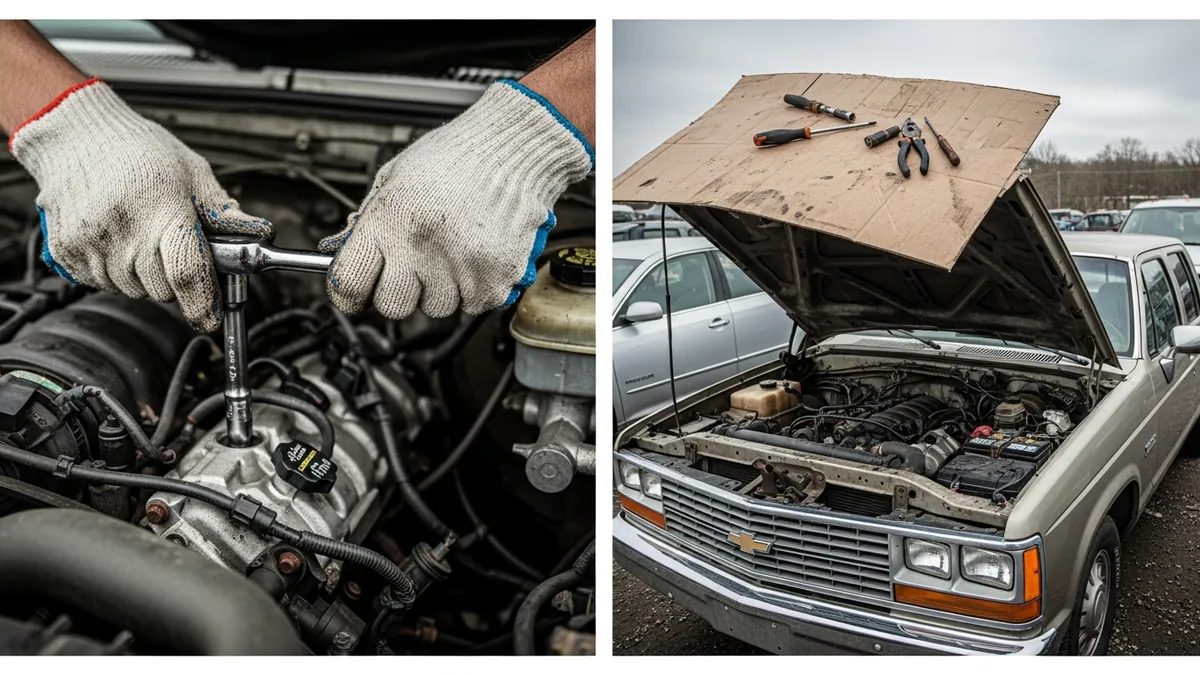
The core tools and why each one earns its space
Six items do the actual work. The rest support them.
Metric socket set, 8mm to 19mm
This is the tool that decides whether the trip works. An 8mm-19mm range covers about 90% of the fasteners on a modern vehicle, and the sizes you will reach for constantly are 10mm, 12mm, 13mm, 14mm, and 17mm. Bring both shallow and deep sockets — deep sockets clear studs that shallow ones bottom out on. A 3/8-inch drive handles general work; a 1/2-inch drive gives you leverage for suspension and subframe bolts. Without the right socket you improvise with a wrench at a bad angle, round the head, and then you need an extractor you did not bring.
Ratchet, extensions, and a universal joint
A ratchet alone reaches almost nothing in an engine bay. Pack a 6-inch and a 12-inch extension plus a swivel or wobble adapter. Bolts behind an intake manifold or a strut tower are geometry problems, not strength problems. A flex-head ratchet buys you angle under a dashboard where a straight handle hits the steering column.
Combination wrenches
For every fastener a socket cannot sit on. Exhaust flanges, brake line fittings, and anything with a bracket welded 3mm away need an open end. Ratcheting wrenches in 10mm, 12mm, 14mm, and 17mm move a bolt in a quarter-inch of swing arc.
Screwdrivers and pliers
A #2 Phillips and a medium flathead cover trim screws, hose clamps, and connector retainers. Add a stubby version of each for door cards. On the pliers side: needle-nose for clips and pins, diagonal cutters for zip ties, and channel locks for hose fittings fused on over 15 years.
Penetrating oil, and the 10-minute rule
Rusted bolts are the number one time-waster at junkyards. A bolt that would spin off a garage-kept car in four seconds will fight you for twenty minutes or shear off entirely.
Build this habit: walk to the car, find every bolt you intend to remove, spray all of them, then go do something else for 10 minutes. Pull a different part. Check the interior. Come back and the oil has had time to wick into the threads. People who spray and immediately wrench get almost no benefit from the can they carried in. A snapped bolt usually means the part comes out damaged or does not come out at all.
Pry bar and trim tools
A short pry bar separates rusted mating surfaces and pops stubborn clips. Plastic trim tools do the same on interior panels without cracking the part you came for. Using a screwdriver on a door card turns a good panel into scrap in one motion.
What yards will not let you bring
Torches, cutting wheels, angle grinders, gas-powered tools, and generators are banned at essentially every self-service yard, and most also prohibit customer floor jacks. Fire risk drives all of it — the lots hold fuel-soaked vehicles parked in rows, and a spark from a cutoff wheel is a real problem.
Battery-powered tools are generally fine. A 1/2-inch cordless impact is the largest time saver you can carry, and an 18V or 20V unit takes lug nuts and suspension bolts off in seconds. Bring a charged spare battery; there is no outlet in row 14.
Policies still differ. Some yards restrict sawzalls, some cap the size of the bag you carry in. Call before you pack — two minutes on the phone beats reloading your trunk in the parking lot. Find yards near you in our junkyard directory, and if you have never pulled a part before, start with our guide to pulling your own parts.
Safety gear you do not skip
Cut-resistant gloves, safety glasses, and closed-toe leather boots are the minimum. A yard is sharp edges, broken glass, and exposed sheet metal, and most injuries there are hand lacerations from reaching into a place you could not see.
Safety glasses matter most under the car. Rust flakes, dirt, and penetrating oil all come straight down when you loosen something overhead. Long pants and long sleeves cover the rest.
Lifting safety. Use rated jack stands, never a jack alone. Most yards ban customer jacks and pre-lift every car for exactly this reason. If a vehicle sits on stands that look bent, wrong, or sunk into soft ground, do not get under it — walk to the next car and tell an employee.

The items people forget
These are the ones that never make the list and always get missed.
- Cardboard or a creeper — a flattened box keeps you off wet gravel and out of spilled fluid. Yards are dirt lots, not shop floors.
- A wagon or folding cart — carrying a 40-pound alternator across a five-acre lot is how a good trip ends early. Some yards loan carts; most do not.
- Labeled hardware bags — bolts and clips get separated the instant they hit your pocket. Bag them per part and write on the bag.
- A headlamp — footwells and the underside of a dash are dark at noon. Hands-free beats a phone flashlight held in your teeth.
- A tape measure — for confirming a bolt pattern or bracket spacing before you spend 40 minutes on the wrong part.
- Cash — some yards are still cash-only at the counter.
Tool priority table
| Tool | What it is for | Priority |
|---|---|---|
| Socket set 8mm-19mm, shallow and deep | Roughly 90% of fasteners on the car | Essential |
| Ratchet, 6in and 12in extensions, swivel | Reaching bolts a socket alone cannot | Essential |
| Combination wrenches 10/12/14/17mm | Flanges and fittings with no socket clearance | Essential |
| Penetrating oil | Rusted fasteners; spray and wait 10 minutes | Essential |
| Screwdrivers and pliers | Trim screws, clips, clamps, zip ties | Essential |
| Gloves, safety glasses, leather boots | Cuts, falling debris, puncture wounds | Essential |
| Cordless impact wrench, 1/2in | Lug nuts, suspension and subframe bolts | Nice to have |
| Pry bar and plastic trim tools | Separating rusted parts, saving interior panels | Nice to have |
| Wagon or cart, cardboard, headlamp | Hauling weight, staying off the ground, seeing | Nice to have |
| Torch, cutting wheel, gas tools, floor jack | Commonly banned — confirm with the yard first | Leave home |
Pack the night before
Loading tools at 7am is how items get left behind. Do it the night before, against a written list.
- Confirm the part. Know the year range and the donor vehicles that share your part before you drive out.
- Call the yard. Ask what tools are prohibited, whether they take cards, and whether the vehicle you found online is still on the lot.
- Pack the core six. Sockets, ratchet and extensions, wrenches, screwdrivers, pliers, penetrating oil.
- Add safety gear and the forgotten items. Gloves, glasses, boots, cardboard, bags, marker, headlamp, tape measure, water.
- Charge everything. Impact batteries, headlamp, and your phone, which is your parts catalog and your camera.
Photograph the assembly before you take it apart. Ten seconds beats an hour of guessing at reassembly. Check the donor vehicle against its VIN before you start pulling — our VIN lookup confirms engine and trim so you are not carrying home a part that will not bolt up. If your own car is the one that is done, see what it is worth on our sell your car page.