How to Test Used Auto Parts Before You Install Them
A salvage part that fails after install costs you the labour twice, because yard warranties replace the part and nothing else. Here is how to test one on your bench in about twenty minutes.
Key Takeaways
- Yard warranties run 30-90 days (LKQ offers 6 months) but replace the part only — your labour is never covered, so a failed part costs you the job twice.
- Most chain parts stores bench test alternators and starters for free, which proves output but says nothing about heat tolerance or bearing life.
- A multimeter on the ohms setting catches open and shorted windings in under a minute on any motor, solenoid, or relay.
- Replace seals, gaskets, and O-rings before install — $3-$15 in parts prevents most reinstall failures.
Why test a used part before it goes on the car?
Because the warranty on a salvage part covers the part and nothing else. Full-service yards typically warranty 30 to 90 days and LKQ offers 6 months, but those policies hand you another unit across the counter and stop there. The four hours on your back under the car, the coolant, the gasket you crushed on the way in — none of it is refundable.
Used OEM typically runs 20-50% of the new dealer price, which is exactly why you bought it. But if the part dies two weeks after install, you do the job a second time for free. Bench testing is the step most people skip, and it is why used parts get a worse reputation than they deserve.
Clean and inspect before you test anything
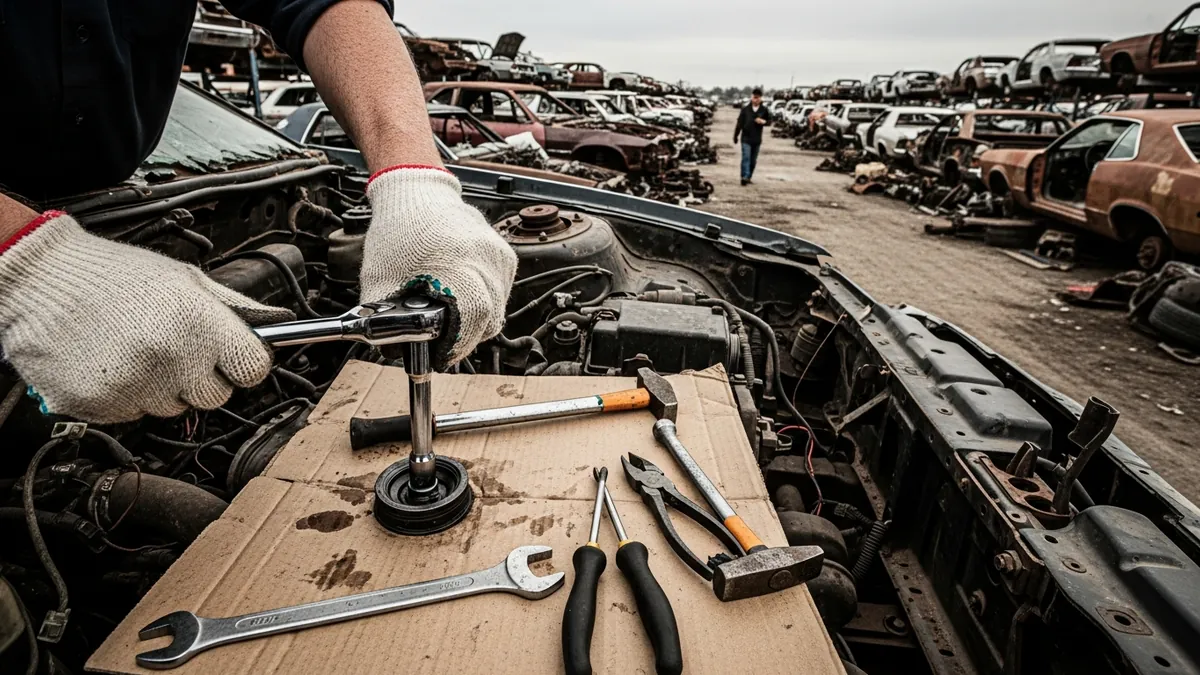
Degrease the part and inspect it dry before a meter or a bench rig goes near it. Grime hides cracked housings, weeping seals, and the hairline split in a connector body that bites you in month two. In this order:
- Degrease and dry. Brake cleaner and a stiff brush, then compressed air. You cannot see a crack through a quarter inch of road film.
- Blow out every connector. Dirt and moisture sit in the pin cavities of anything that spent years under a hood. Compressed air first, contact cleaner second.
- Inspect the pins. Green or white powder is corrosion, and corrosion in a signal circuit causes intermittent faults you will chase for weeks. Bent or pushed-back pins are just as bad and easier to miss.
- Check ears, threads, and seal surfaces. A cracked mounting ear or stripped bolt hole means the part cannot be torqued correctly. A dried fluid trail leading away from a seal means it was leaking on the donor car. Either one, walk away.
The free bench test at chain parts stores
Most national chain parts stores bench test an alternator or a starter for free, whether or not you bought it there, which is worth knowing before you spend an hour pulling an alternator off a donor car. Their rig spins the unit under load, reads output voltage and amperage, and prints a pass or fail. Walk in and ask — no purchase required at most locations.
What it proves: the unit makes rated output at room temperature, the regulator responds, and the starter solenoid pulls in and cranks. What it does not prove: how the part behaves at 200 degrees under a hood, how many miles are left on the bearings, or whether the diode pack is marginal rather than dead. I have installed alternators that passed on the rig and threw a charging light three weeks later when summer arrived. Use the test to reject bad parts, not to certify good ones.
Hand checks that need no tools
Your hands catch failures an electrical test misses. Bearing wear, binding, and internal play show up as feel long before they show up as a reading.
- Spin every pulley — an alternator pulley turns with slight magnetic resistance and no grinding. One that spins totally free suggests a disconnected rotor; one that grinds has shot bearings.
- Rock the shaft — grab the pulley at 12 and 6 o'clock and push sideways. Any perceptible play is a worn bearing, and the part will howl within a month.
- Work every latch and linkage — latches, window regulators, and shifter linkages should move smoothly through full travel. Binding anywhere means a bent or worn mechanism.
- Turn motors by hand — on window regulators and wiper motors, a notchy feel means dry bushings or a chipped gear tooth.
Multimeter checks on the bench
Set your meter to ohms and check resistance across the windings of any motor, solenoid, or relay coil. OL means an open winding and a dead part. Near zero ohms on a coil means a short. Most solenoid and motor windings land between 0.5 and 10 ohms.
Continuity mode handles the rest. Check pin-to-pin continuity on switches at every position, confirm ground pins reach the housing, and confirm no two isolated pins read continuity. On relays, apply 12V to the coil terminals and listen for the click.
Airbag and SRS warning
- Never probe a yellow SRS connector with a multimeter. Meter current can fire an inflator. Yellow connectors and harnesses are supplemental restraint circuits — leave them alone.
- Disconnect the negative battery terminal and wait 15 minutes minimum before working near SRS wiring, so the capacitors discharge.
- Store any airbag module face up, never face down. OSHA has documented that untrained handling can cause deployment, exposing workers to sodium azide.
- Do not buy used airbags or SRS components at all. Counterfeit airbags are a documented US problem, and the EPA classifies undeployed inflators as reactive hazardous waste under RCRA.
How to test common salvage parts
| Part | How to test it | What a failure looks like |
|---|---|---|
| Alternator | Free store bench test; spin and rock the pulley | Low or no output; grinding pulley; shaft play |
| Starter motor | Free store bench test, or jumper 12V and watch the gear throw | Clicks with no crank; gear fails to extend; high draw |
| Window regulator / motor | 12V both polarities, run full travel twice | Stalls mid-travel; stripped nylon gear; frayed cable |
| Radiator fan assembly | Spin blades by hand, then 12V direct | Slow spin-up; bearing rumble; cracked or chipped blade |
| Water pump | Check the weep hole; rock the pulley for play | Wet weep hole; shaft wobble; impeller corrosion |
| Door latch / lock actuator | Work the latch by hand; 12V to the actuator | Latch sticks; actuator hums without moving |
| Switch or relay | Continuity at each position; 12V on the relay coil | Dead position in the sweep; no click |
| Body control or ECU module | Visual on the board and pins only | Water staining; swollen caps; corroded pins; burnt smell |
Compare it against your old part before you touch a wrench
Put the used part and the failed part side by side and match them physically. Catalog numbers get typed wrong, yards mislabel shelves, and a part that fits a 2009 model may not fit a 2010 after a mid-cycle change. Check four things: connector count and pin arrangement, bracket geometry and bolt hole spacing, pulley diameter and belt groove count, and shaft or spline length. A three-pin plug where you need a four-pin plug is a different part, whatever the shelf tag said. If the geometry is close but not identical, verify with a Hollander interchange lookup, and confirm the donor engine code using digit 8 of the VIN through a VIN decoder.
Replace these before installation
Seals, gaskets, and O-rings cause more reinstall failures than dead components do, and they cost $3-$15. Any rubber part off a donor car has been heat-cycled for a decade and compressed into a shape it will not return to.
- O-rings and seals — water pump gaskets, thermostat O-rings, sensor seals, axle seals. Buy new every time.
- Mounting hardware — replace any bolt with damaged threads or a rounded head. Torque-to-yield bolts are single-use.
- Filters and fluids — anything you drain goes back in fresh, not strained through a rag.
Never buy these used at all, however well they test: brake pads and rotors, tires, airbags and SRS components, timing and serpentine belts, and fuel system parts including pumps, injectors, and filters. No bench test makes a ten-year-old fuel pump a reasonable bet.
Where testing fits in the buying process
Test at home the same day you buy, while the yard's return window is open. Some parts never make it to a bench at all, which is why a used engine has to be inspected on the pallet before money changes hands. A good yard will exchange a part that fails a bench test if you come back promptly with your receipt. Wait three weeks and that conversation goes differently.
Browse yards by location in our salvage yard directory, and read the broader guide to buying used auto parts for grading and pricing.