How to Buy Used Auto Parts from Salvage Yards: The Complete Buyer's Process
Buying used parts saves 50-80% over the dealer, but only if you get fitment right first. Here is the exact process, from VIN digit 8 to core charges.
Key Takeaways
- Used OEM parts typically sell for 50-80% below new dealer pricing, and self-service yards run another 30-60% cheaper than full-service yards.
- VIN digit 8 is the engine code — one character that decides whether an engine, transmission, or exhaust manifold will fit your car.
- Full-service yards warranty parts 30-90 days; LKQ offers 6 months. Self-service yards usually sell as-is with a short exchange window.
- Never buy used: brake pads, rotors, tires, airbags, timing and serpentine belts, and fuel system components.
The used auto parts buying process, start to finish
Buying a used part takes six steps: identify the exact part, verify fitment with an interchange number, find yards that stock it, price it against new OEM and aftermarket, inspect it before you pay, then confirm the warranty and core charge. Skip the fitment step and you will end up with a part that bolts on and still does not work.
The supply is not the problem. According to the Automotive Recyclers Association, the industry runs more than 9,000 locations across the United States and generates $32 billion in annual sales, and roughly 95% of vehicles retired from use in this country get recycled in some form. The problem is matching one specific casting to one specific car.
Two types of yards sell to the public. Self-service yards (U-Pull-It) charge a $2-$5 entry fee, hand you a wristband, and let you pull anything you can carry out. Full-service yards pull the part for you, test it on a bench or a running car, and stand behind it. Self-service pricing runs 30-60% below full-service. You cover that difference with your own labor and your own risk. Our salvage yard directory lists both types by state and ZIP, and the complete guide to finding junkyards near you breaks down what to expect at each.
Step 1: identify the exact part you need
Year, make, and model are not enough. You need year, make, model, trim level, engine displacement, and engine code before you call a single yard. A 2014 Honda Accord came with a 2.4L four and a 3.5L V6 that share almost no drivetrain hardware, and the LX and Sport trims of that same 2.4L use different exhaust and suspension parts.
Pull the engine code from VIN digit 8
The eighth character of a 17-digit VIN is the engine code. Count from the left. That character separates a 5.3L LMG from a 5.3L LC9 in the same GM truck, and those two engines differ in fuel system and accessory drive. Any yard clerk worth talking to will ask for it. Run your VIN through our free VIN lookup tool to decode the year, plant, engine, and body style before you shop, and check the title history on NMVTIS or vincheck.info if you are buying a whole donor vehicle.
Read the numbers cast into the part itself
Every serious part carries identification stamped or cast into the metal. Cylinder heads and blocks carry casting numbers. Alternators, starters, and ECUs carry OEM part numbers on a riveted or printed tag. GM vehicles carry RPO codes on a sticker in the glove box or trunk lid — a three-character code like LC9 or MN6 naming the exact engine and transmission the car left the factory with.
Step 2: verify fitment before you hand over money
Fitment verification means matching your part to a Hollander Interchange number, which is the standard salvage industry catalog. Hollander assigns a part number plus an application range listing every year, make, and model that shares that part, along with variance codes that flag differences like manual versus automatic, with or without tow package, or California emissions.
Three checks catch most bad purchases. First, confirm the interchange number matches. Second, confirm the variance codes match your car's options — a tow-package radiator and a base radiator carry the same interchange root and will not swap. Third, physically compare the old part to the new one: connector count, bolt pattern, pulley diameter, plug orientation. Do this in the yard before you pay, not in your driveway on Sunday.
Interchange means compatible, not identical. Two donors can share an interchange number and still use different connectors after a mid-cycle supplier change. When the catalog and the physical comparison disagree, trust the part in your hand.
Step 3: where to search for used parts
Three sources cover almost every search: a salvage yard directory to find yards near you, Car-Part.com to search live inventory across yards, and the phone to confirm what is actually on the shelf.
Car-Part.com for live inventory
Car-Part.com aggregates 150-250 million parts from roughly 3,100 recyclers in North America. You enter year, make, model, and part, then filter by distance, mileage, price, and grade. It is the same system most yard counters run internally, so what you see is close to what they see. Listings show donor mileage and a quality grade, and most include the yard's phone number.
Its weakness is coverage. Small independent yards and most self-service operations do not upload inventory, so zero results does not mean no yard has it.
Understand the grade before you filter on it
The Automotive Recyclers Association publishes the grading scale that listings use. Damage is counted in units, where one unit is an area a credit card would cover. Grade A is 0.0 to 1.0 units, Grade B is 1.1 to 2.0, and Grade C is 2.1 or more but still usable. Body parts also carry an ARA damage code describing the location, type, and size of the damage, and a code of 000 means no damage at all. Filtering for Grade A on a body panel and ignoring the damage code is how people end up sanding a "clean" fender.
Directories and yard-by-yard calls
For local searching, work from a yard directory or the Automotive Recyclers Association member locator, which lists yards that carry certification and insurance. Then call. Ask three things: do you have a donor vehicle in that year range, has the part already been pulled, and what is the price with tax and core.
Self-service yards will tell you which row a vehicle sits in but almost never whether the part is still on it. Ask when the vehicle was set out — a car that has sat three weeks has been picked over.
Step 4: what a fair price looks like
A fair used OEM price lands at 20-50% of the new dealer price for the same part number. Full-service yards typically price at 40-50% of new OEM. Self-service yards price by part category rather than by vehicle, so an alternator costs the same whether it came from a Corolla or a Suburban, often $25-$45.
Compare against new first. Pull the OEM price from a dealer parts counter and the aftermarket price from RockAuto. On high-wear consumables, new aftermarket usually wins.
| Factor | Used OEM (salvage) | New OEM (dealer) | New aftermarket |
|---|---|---|---|
| Price | 20-50% of new OEM | Highest; the baseline | 40-70% of new OEM |
| Fitment certainty | High if interchange verified; you get the exact factory casting | Highest; matched by VIN at the counter | Variable; clearance and connector issues are common |
| Warranty | 30-90 days typical, 6 months at LKQ, as-is at self-service | 12-24 months from the manufacturer | 90 days to lifetime depending on brand |
| Availability | Best for vehicles 5-20 years old; thin for brand-new models | Strong for current models; discontinued after roughly 10-15 years | Broad on common wear items; poor on body and trim |
| Best use | Body panels, glass, interior, engines, transmissions, modules | Safety systems and anything electronically coded to the car | Brakes, filters, belts, hoses, suspension wear parts |
Core charges and what they mean
A core charge is a refundable deposit on the part you are replacing. Buy a used alternator with a $25 core and you pay $25 extra until you bring back your old alternator. Cores exist because rebuilders need the housings and castings, so yards want the old unit back in one piece.
Two rules. Ask whether the quoted price includes core before you agree to it, because a $90 part with a $40 core is a $130 transaction at the register. And check what condition the core must be in — a cracked case or a missing pulley can void the refund. Bring the old part with you when you can.
Step 5: inspect the part before you pay
Inspection takes five minutes and prevents the single most expensive mistake in salvage buying. For a mechanical part, you are looking for evidence of how the donor car was maintained. For an electrical part, you are looking for corrosion, heat damage, and broken connector tabs.
Engines
Pull the oil fill cap and look underneath. Milky or foamy oil means a blown head gasket — walk away. Thick black sludge means the owner never changed the oil, which tells you what the bearings look like. Check the dipstick for metal shavings, which point to bearing failure. Turn the crank by hand with a socket on the balancer if the engine is out; it should rotate smoothly without catching.
Transmissions
Check the fluid on the dipstick if the unit has one. Healthy ATF is red or pink and smells faintly sweet. Burnt dark-brown fluid means internal damage and clutch material in the pan. Look at the bellhousing for cracks and at the input shaft for play. On a manual, spin the input shaft and listen for bearing noise.
Pumps, alternators, and accessories
Water pumps have a weep hole on the underside of the housing. If it is wet or crusted with dried coolant, the seal has failed and the pump is scrap. Spin an alternator pulley by hand: it should turn with slight magnetic resistance and no grinding, no wobble, no roughness. Rock a pulley side to side to check the bearing. On any electrical connector, look for green corrosion on the pins and melted or discolored plastic around the terminals.
Bring your own tools if you are pulling the part yourself. A socket set covering 8mm-19mm handles roughly 90% of the fasteners you will meet in a salvage yard.
Which parts are safe to buy used
Buy used when the part is mechanical, non-wearing, expensive new, or discontinued. That covers most of what people actually need.
- Body panels and bumpers — doors, fenders, hoods, tailgates, mirrors. A used door in factory color saves several hundred dollars over new plus paint.
- Glass — door glass, quarter glass, and back glass are effectively unbreakable-in-storage and cost a fraction of new.
- Interior components — seats, door panels, dash bezels, center consoles, carpet, sun visors, trim clips.
- Engines and transmissions — the largest dollar savings in the yard, provided you get the donor VIN and mileage in writing.
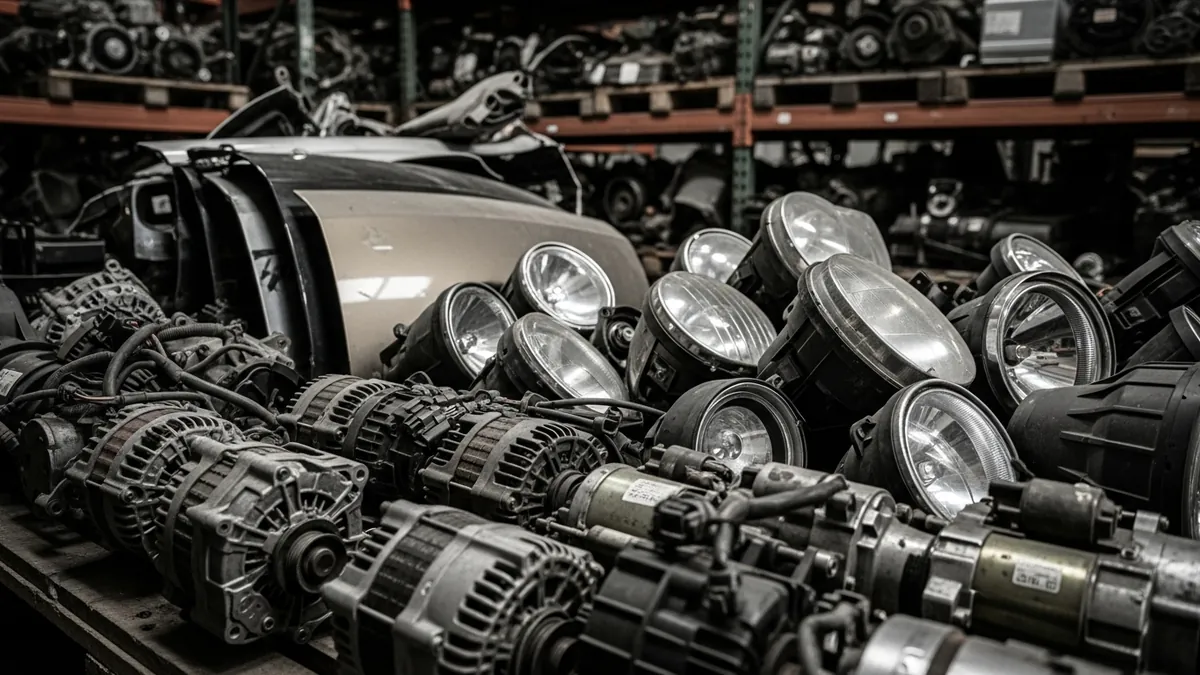
- Alternators, starters, and A/C compressors — check them physically first; a full-service yard bench-tests these.
- Electronic modules — ECUs, BCMs, radios, cluster assemblies. Confirm whether the module needs dealer programming to your VIN before you buy.
- Lighting assemblies — headlights, taillights, and fog lamps, as long as the housing is not cracked and the lens is not fogged internally.
Which parts are never worth buying used
Some parts are worn out by definition or carry safety risk that no discount justifies. Buy these new, every time.
- Brake pads and rotors — friction material is a consumable with unknown remaining life, and a used rotor may be under minimum thickness with no way to tell by eye.
- Tires — sidewall age, internal belt damage, and prior repairs are invisible from outside. A used tire failure at highway speed is a wreck.
- Airbags and SRS components — counterfeit airbags are a documented problem in the United States, with fake modules sold through online marketplaces that fail to deploy or deploy with metal fragments. Buy airbag components new from a dealer, or not at all.
- Timing belts and serpentine belts — rubber degrades on a shelf whether the belt was used or not. A $30 timing belt that snaps destroys an interference engine.
- Fuel system components — fuel pumps, injectors, and filters carry contamination and unknown wear, and a fuel leak is a fire.
Warranty and return policies by yard type
Full-service yards offer 30-90 day replacement warranties on most mechanical parts, and LKQ extends 6 months on many items. Self-service yards generally sell as-is, though many allow a same-part exchange within 30 days if you keep the receipt and the yellow paint mark they put on the part at checkout.
Ask four questions at the counter. Is the warranty replacement-only or does it include a refund? Does it cover labor if the part fails after installation? Does the clock start at purchase or at installation? And what voids it — most warranties are void if you disassemble the part or install it without a new gasket set. Get the answers on the receipt, not in conversation.
How to avoid getting scammed
Demand the donor vehicle's 17-digit VIN for any engine, transmission, ECU, or airbag module. A legitimate recycler has it in their inventory system and will read it to you without hesitation. A seller who refuses, stalls, or gives you a 10-digit number is either running stolen parts or does not know what they are selling.
Run that VIN through NMVTIS or vincheck.info to confirm the vehicle exists, matches the year and engine claimed, and was not reported stolen. For engines and transmissions, ask for the donor's odometer reading and get it written on the invoice. If you are selling rather than buying, our guide to what your junk car is worth covers the other side of this transaction, and you can get an offer here.
Safety warnings you cannot skip
Three systems in a salvage vehicle can injure or kill you.
Airbag and SRS systems. Disconnect the battery negative terminal and wait 15 minutes before touching anything SRS-related, because the module holds a charge. Never probe or test yellow SRS connectors with a multimeter. OSHA has documented that untrained workers dismantling vehicles can trigger deployment and expose themselves to sodium azide, and the EPA classifies undeployed inflators as reactive and ignitable hazardous waste under RCRA. Never set an intact undeployed module face down — if it fires, it launches.
Hybrid and EV high voltage. Orange cables carry 300-800V DC. That is lethal, and standard mechanic gloves do not protect you. High-voltage battery and cable work is not a DIY job. Leave orange alone unless you have insulated Class 0 gloves and training.
Fuel systems. Relieve fuel pressure before opening any line, work outdoors or with strong ventilation, and keep a Class B fire extinguisher within reach. Fuel that has sat for months still ignites.
Put the process together
Write down year, make, model, trim, engine code from VIN digit 8, and any casting or RPO number. Get the Hollander interchange number. Search Car-Part.com and a local directory, then call to confirm the part is still on the car. Price it against new OEM and aftermarket, inspect it in person, and confirm the warranty, core charge, and donor VIN before you pay.
Done in that order, a used OEM part is the same casting the factory installed at a third of the price. Done out of order, it is a heavy paperweight with an exchange window you already missed.