Buying a Used Catalytic Converter: What's Legal in Your State
A converter cut off a junkyard car is cheap, but in most cases you can't legally bolt it onto your car. What EPA allows, which states ban used converters outright, and what to buy instead.
Key Takeaways
- EPA considers it a violation to install or sell a junkyard converter for reuse unless it has been properly tested and labeled. A converter you pull yourself is neither.
- California, New York, Maine, and Colorado ban the sale and installation of used, recycled, or salvaged converters outright.
- A legal used converter carries an EPA label starting with "U/", and it can only go on the vehicle type it was built for.
- On 1995 and newer vehicles the factory converter is warranted for 8 years or 80,000 miles. Check that before you buy anything.
In most of the country, a catalytic converter pulled from a junkyard car is not legal to reinstall as-is. Federal EPA policy allows a used converter only after a reconditioner has bench-tested and labeled it, and four states (California, New York, Maine, and Colorado) ban used converters entirely. Buy a new OEM unit or a properly certified aftermarket converter instead.
Is it legal to buy a used catalytic converter from a junkyard?
Buying one as scrap is a different question from installing one, and the installation is where the law bites. EPA's fact sheet on its aftermarket converter policy says it is a violation to install a used converter from a salvage yard, or to sell it for reuse, unless it has been properly tested and labeled. It is also a violation to install an untested used converter that a customer brings in, even if the customer says it came off the same car.
The policy dates to August 5, 1986, and it applies to the anti-tampering section of the Clean Air Act, section 203(a)(3). EPA notes that the 1990 Clean Air Act amendments expanded that prohibition from repair businesses to "any person," which means a DIY install in your driveway is not exempt. Salvage yards can also be held liable for causing tampering if they sell untested converters that are later installed.
Plenty of U-pull yards have simply stopped offering them. Pull-A-Part, for example, states on its parts pricing page that it removes catalytic converters during incoming vehicle processing, recycles them, and does not sell them at any Pull-A-Part or U-Pull-&-Pay store.
What makes a used converter legal under federal rules?
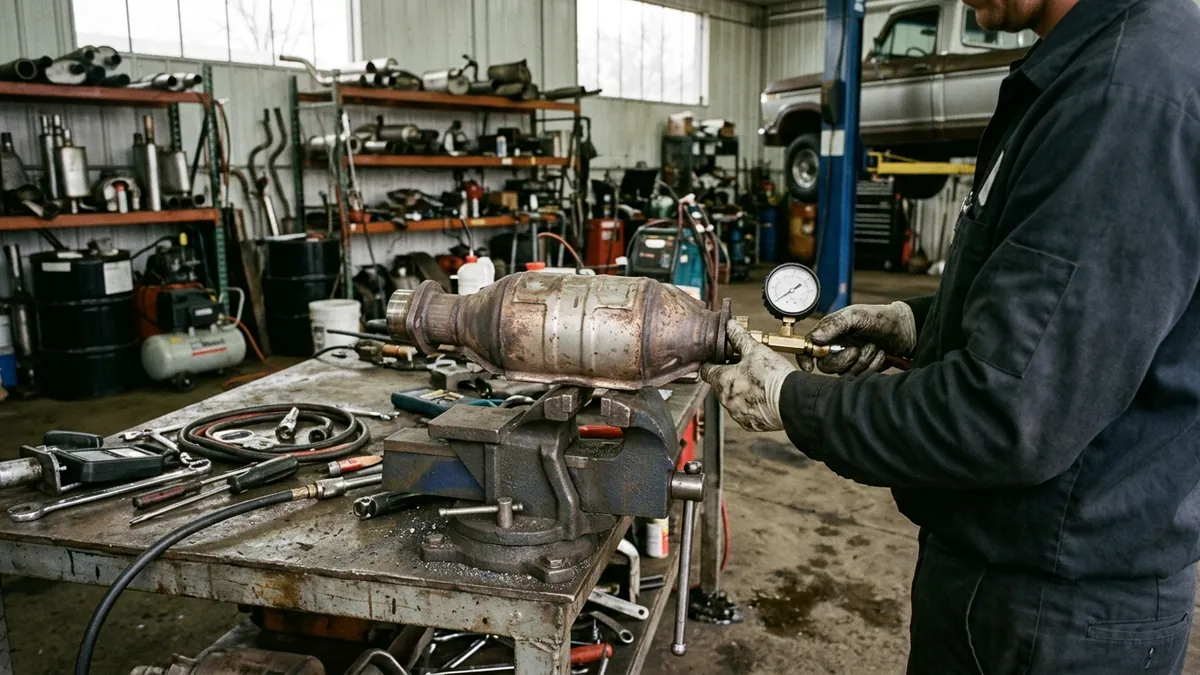
A used converter is federally acceptable only if a reconditioner has tested it and labeled it, and only on the vehicle it was designed for. EPA's policy says reconditioners of used converters may only use original equipment converters and must bench-test each one to show it still performs.
The label is how you tell. EPA requires labels in this format:
- N/XX/YYYY/ZZZZ for new aftermarket converters
- U/XX/YYYY/ZZZZ for used converters
- XX is the manufacturer code issued by EPA, YYYY is usually the vehicle application or part number, and ZZZZ is the month and year of manufacture
Even a properly labeled converter has limits. EPA says a used converter can only be installed on the type of vehicle it was originally intended for, and any aftermarket converter (new or used) can generally be installed in only three situations: the original is missing, a state or local inspection program has found that the existing one needs replacement, or the vehicle is past 5 years or 50,000 miles (8 years or 80,000 miles for 1995 and newer vehicles) and a legitimate need such as a plugged converter has been documented.
Which states ban used catalytic converters?
According to their own regulators, four states ban used, recycled, or salvaged converters for installation. All four also require new aftermarket converters to carry a California Air Resources Board (CARB) Executive Order.
| State | Used converter ban effective | Legal replacements | Rule |
|---|---|---|---|
| California | July 2008 (CARB lists July 10, 2008 for the end of certified used converter sales) | OEM, or new aftermarket with a CARB Executive Order for your vehicle | 13 CCR 2222(i) |
| New York | January 1, 2014 | OEM, or CARB-approved aftermarket (required on any model year since January 1, 2023) | 6 NYCRR 218-7.2(c) |
| Maine | June 1, 2018, all vehicle types | OEM or CARB-certified new aftermarket on covered 2001 and newer gasoline vehicles | Maine DEP converter standards |
| Colorado | January 1, 2021 | New OEM, or new aftermarket exempted under CARB rules | AQCC Regulation 20 |
California's regulation is blunt: since July 1, 2008, no person may install, sell, offer for sale, or advertise any used, recycled, or salvaged catalytic converter in the state. Colorado's health department summarizes its rule the same way, noting that even certified used OEM converters may not be sold for use or installed after January 1, 2021. Maine's ban covers every vehicle type, not just newer cars.
Other states can adopt California's converter rules, and retailers sometimes publish longer lists of "CARB states." Treat those lists as a starting point and confirm with your own state's air quality or environmental agency before you buy.
How do you confirm converter fitment?
Converters are matched by engine and by emissions certification, not just by make and model. CARB says that to find the correct aftermarket part you need the vehicle's make, model, model year, engine size, and test group or engine family designation. The test group appears on the emissions label under the hood.
- Decode the VIN first. Run it through our free VIN decoder to confirm the exact engine and trim.
- Read the emissions label. It tells you whether the car was certified to California standards or federal standards, which changes which converters are legal in some states.
- Match the OE part number. Factory converters usually carry a stamped part number on the shell. Our Hollander interchange guide explains how yards cross-reference parts between models.
- For new aftermarket units in CARB states, look up the CARB Executive Order. Maine DEP notes that the EO number always begins with "D-" and is stamped on the shell along with the part number and a flow-direction arrow.
What to inspect if you are buying a converter at the yard
Where a used converter is legal (a tested, U-labeled unit, or one you are buying as a core or for scrap value), inspect it before you pay. What matters is inside the shell.
- Shake it. A rattle usually means the ceramic substrate has broken loose, and that converter will not pass emissions. It may also block flow.
- Look into both ends for an intact honeycomb. Melted, glazed, or missing sections point to overheating from misfires or a rich mixture.
- Check for heavy black or white crust. That residue suggests the donor engine was burning oil or coolant.
- Look hard at the flanges and sensor bungs. A cracked flange or a stripped oxygen sensor thread turns a cheap part into a fabrication job.
- Find the label. No U-label, no federal reuse eligibility.
If you are pricing converters as scrap rather than for reuse, our catalytic converter value guide covers how buyers grade them.
Why catalytic converters fail, and why a used one may not fix the problem
Most converters die because of an engine problem upstream, so replacing the converter without fixing the cause kills the replacement too. EPA's fact sheet says original converters are designed to last the life of a properly tuned and maintained vehicle, and that a properly tuned engine is critical for long converter life.
The common culprits are misfires that dump unburned fuel into the exhaust, oil burning from worn rings or valve seals, and coolant entering the combustion chamber. Diagnose and repair those first. EPA also notes that a used converter's performance and remaining life depend on its prior use history, which you cannot verify on a yard car.
When should you buy new instead of used?
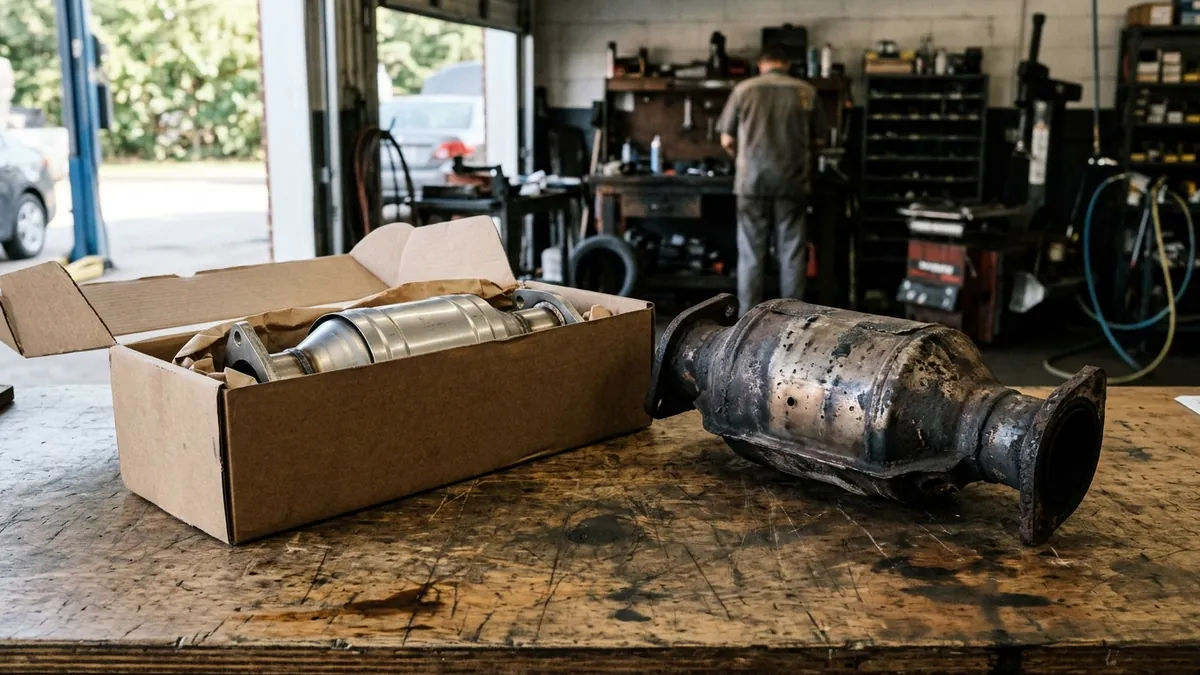
Buy new if you live in a used-converter ban state, if the vehicle is still under its emissions warranty, or if the car has OBD II and must pass an inspection. In practice that covers most drivers.
Check the warranty before anything else. EPA says the factory converter on 1995 and newer vehicles is warranted for at least 8 years or 80,000 miles, so a defective original may be replaced free by the manufacturer.
New parts also come with a guarantee that used ones don't. Federal aftermarket converters must carry a 5-year/50,000-mile warranty on the shell and end pipes and 25,000 miles on emissions performance. Maine and Colorado require CARB-certified units to be warranted for 5 years or 50,000 miles.
On a newer car, stick to the converter maker's application catalog. EPA cautions that newer OBD vehicles may not operate properly with certain aftermarket products.
Warranty and return considerations
Used converters carry no legally required warranty. EPA's policy says used converters only have to meet performance requirements at the time of sale, with no additional warranty required. Any return window is the seller's own policy.
Most self-service chains publish their return terms, and they vary. Pick Your Part, for example, offers an optional paid 90-Day Worry-Free Guarantee on parts and states that everything else is sold as-is. Pull-A-Part does not sell converters at all. Ask before you pull, and keep the receipt. Our guide to buying used parts at salvage yards compares warranty and return policies by yard type.
How to find a yard near you
Whether you start from a "used auto parts near me" search or our directory of junkyards that sell parts, call ahead. Ask two questions: does the yard remove converters before cars go on the lot, and does it sell any tested, labeled used converters. If you are in a ban state, browse yards in California, New York, or Colorado for other parts, and buy the converter itself new.
This is general information, not legal advice. Rules change; confirm with EPA or your state air quality agency before you buy or install a converter.
Sources
- U.S. EPA: What You Should Know About Using, Installing, or Buying Aftermarket Catalytic Converters (accessed October 2026)
- Cornell LII: Cal. Code Regs. Tit. 13, § 2222, Add-On Parts and Modified Parts (accessed October 2026)
- California Air Resources Board: Aftermarket Catalytic Converters (accessed October 2026)
- New York State DEC: Guidelines for Selling and Installing Aftermarket Catalytic Converters in New York State (accessed October 2026)
- Maine DEP: Maine's Catalytic Converter Standards (accessed October 2026)
- Colorado Department of Public Health and Environment: Aftermarket Catalytic Converters (accessed October 2026)
- Pull-A-Part: Used Auto Parts Price List (accessed October 2026)
- Pick Your Part: Sales Policies (accessed October 2026)