Buying a Used ECU or PCM: Part Numbers, VIN Programming, and Immobilizers
A junkyard engine computer costs a fraction of a new one, but it rarely just plugs in. How to match part numbers, what VIN and immobilizer programming involves, and when a used module is the wrong call.
Key Takeaways
- Match the exact part number on the module label. Identical-looking ECUs can differ by engine, transmission, and emissions package.
- On most immobilizer-equipped cars, a used ECU must be programmed to your VIN and keys before the engine will start.
- EPA rules require SAE J2534 pass-through reprogramming support on 2004 and newer OBD vehicles with reprogramming capability.
- As of October 2026, Pick Your Part posted engine control modules at $68.50 to $70.50 plus a $5.00 core at two of its stores.
A used ECU or PCM from a junkyard can save real money, but on most cars built in the last two decades it will not simply plug in and run. You need a module with the exact part number, a programming plan for your VIN and immobilizer, and a fixed root cause for the original failure. Price the programming before you pull the part.
Will a junkyard ECU work in your car?
A used engine computer works only when its hardware matches your vehicle and its software and security data are set up for your VIN and keys. Older vehicles without an engine immobilizer were sometimes plug-and-play with an identical part number. Newer vehicles usually store the VIN and immobilizer data in the module, so a computer from another car may crank but refuse to start.
Know which module you are shopping for. An ECM (engine control module) runs the engine. A PCM (powertrain control module) handles the engine and, on many vehicles, the transmission in one unit. Some vehicles use a separate TCM (transmission control module). Salvage yards and interchange listings may use any of these names, so match by part number and location in the vehicle rather than by the label on the inventory sheet.
None of that makes a used module a bad buy. The purchase price is just one part of the cost. Before you head to the yard, call a dealer or an independent shop that does module programming and ask what your make needs: a VIN write, a software flash, an immobilizer or key relearn, or all three.
How do you match ECU part numbers?
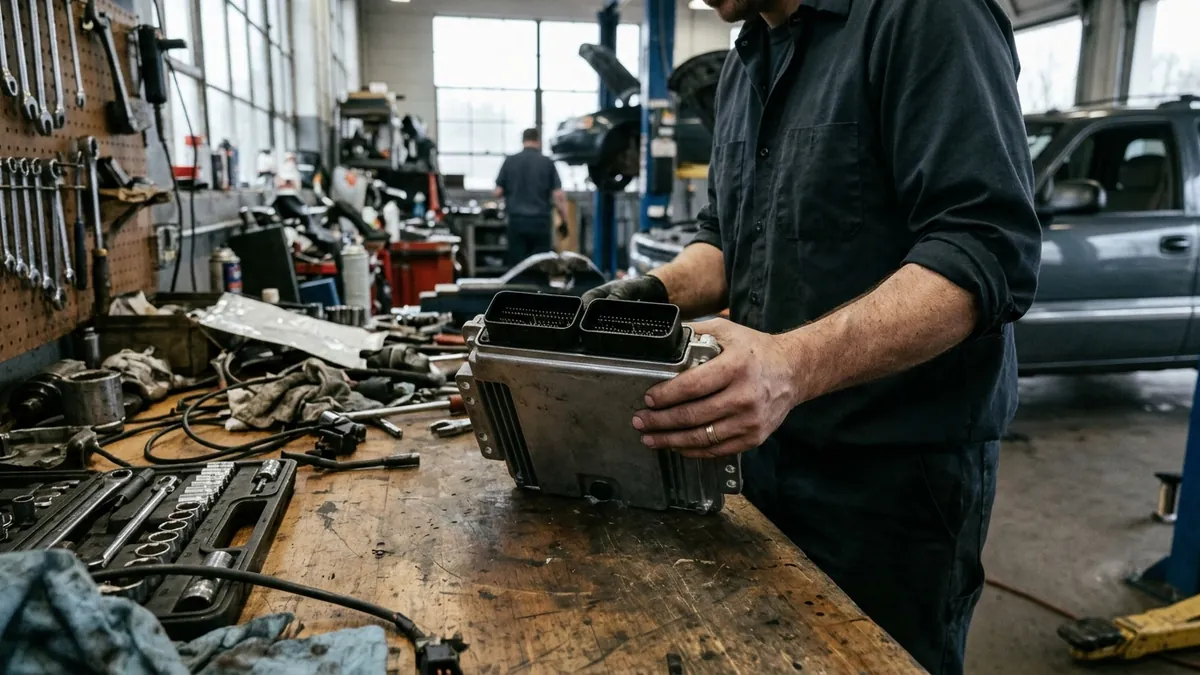
The manufacturer part number on the module label is the fitment test that matters. Modules for the same model can differ by engine, transmission, model year, and emissions certification, and a module that bolts in and connects can still carry the wrong calibration.
- Decode your VIN with our VIN lookup to pin down engine, transmission, and model year.
- Read the label on your old module. Write down every number on it. The hardware part number and any software or calibration number can both matter.
- Confirm with a dealer parts counter. Give them your VIN and ask for the current service part number. Superseded numbers are common.
- Use interchange to find donors. Our Hollander interchange guide explains how yards cross-reference modules, and our guide to searching junkyard inventory online helps you find the donor.
- Record the donor VIN and mileage. Our VIN parts guide explains why the donor VIN matters for VIN-locked modules.
What VIN and immobilizer programming involves
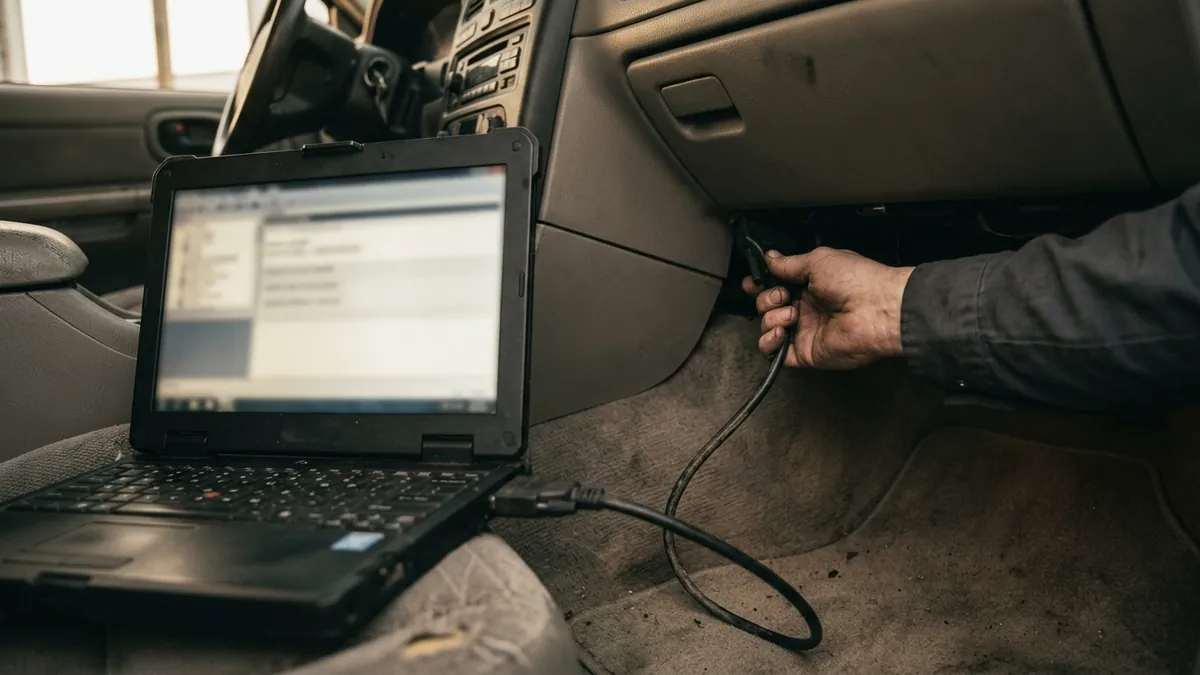
Programming a used ECU usually means three separate jobs: loading the correct software calibration, writing your VIN, and pairing the module with your vehicle's anti-theft system and keys. Which ones you need depends on the manufacturer.
Federal emissions rules give independent shops a path for the first two. Under 40 CFR 86.1808-01, manufacturers must comply with SAE J2534 pass-through reprogramming for 2004 and later OBD vehicles that have reprogramming capability, and must make the manufacturer-specific software and calibrations available to aftermarket service providers. The same rule requires manufacturers to make computer and anti-theft system initialization information needed to properly install an on-board computer available at a fair and reasonable cost.
Security functions are more tightly controlled. Toyota's Technical Information System, for example, says access to vehicle security information is provided for security professionals registered with the NASTF Vehicle Security Professional Registry. Its subscription tiers separate diagnostics and ECU calibrations from security functions such as key codes and immobilizer reset. Other manufacturers have their own systems, so ask a shop that works on your brand.
Questions to ask the programming shop before you buy:
- Can you program a used module for my make, or only new ones?
- Do you need the donor VIN, my old module, or both?
- Will my existing keys work, or will they need to be relearned?
- What do you charge, and is it refundable if the used module will not accept programming?
| Replacement path | What it needs | Main risk |
|---|---|---|
| Used module, same part number, older non-immobilizer vehicle | Exact part number match; confirm no programming required | Unknown history of the donor module |
| Used module plus programming | Software flash, VIN write, and immobilizer or key relearn by a capable shop | Some used modules cannot be reprogrammed or re-paired |
| Remanufactured module programmed to your VIN | Your VIN and sometimes your old module or security data | Higher cost; immobilizer steps may still be needed |
| New module from the dealer | Dealer programming and security setup | Highest parts cost |
Inspection checklist at the yard
Electronic modules hide most of their problems. At the yard you are ruling out obvious damage and documenting the donor, nothing more. Five minutes of looking can save you a programming bill on a dead module.
- Check the donor car for water. Silt lines, mildew, or a wet carpet point to a flood car, and water kills electronics.
- Pins in the connectors should be straight and clean, with no green corrosion, melted plastic, or pushed-back terminals.
- Reject a case with cracks, burn marks, or a scorched smell. Do not open a sealed case.
- Read the whole label. If it is missing or unreadable, you can't match the part number.
- Photograph the donor VIN and odometer. The programming shop may ask for the donor VIN.
- Unplug carefully: disconnect the donor battery if it is still installed, and release connector locks rather than prying.
For bench checks you can do at home before installation, see our guide to testing used parts before installing.
Why ECUs fail, and why a used one may fail the same way
An engine computer often fails because of something outside it, so swapping the module without finding the cause can destroy the replacement. Shorted actuators such as injectors, ignition coils, or solenoids can overload the driver circuits inside the module. Water intrusion, corroded grounds, and charging system faults are other common suspects.
Before installing a used module, have the circuits it controls checked for shorts and confirm the grounds and battery voltage are healthy. A scan tool reading of stored codes from the old module, if it still communicates, can point to the circuit that failed.
When should you buy new or remanufactured instead?
Skip the junkyard module when programming costs or access make the savings disappear. That happens more often on newer vehicles with tighter security systems.
- No local shop can program your make, and the dealer will only program modules it sells.
- Your vehicle needs online security access that you or your shop cannot get.
- You cannot find a donor with your exact part number.
- The car is still under a powertrain or emissions warranty that may cover the module.
- A remanufacturer offers the module pre-programmed to your VIN with a warranty that costs less than used plus programming.
Warranty and return considerations
Return windows on electronics are short and programming costs are usually not refundable, so test the module quickly. Pick Your Part's optional 90-Day Worry-Free Guarantee allows a refund within 90 days with the original receipt when the part is marked, and the chain states parts are otherwise sold as-is. Pull-A-Part offers a 30-day exchange or store-credit window on most parts, with an optional 120-day extended warranty on some part types.
The posted prices are low enough that the guarantee is worth considering. As of October 2026, Pick Your Part listed an engine control module at $68.50 plus a $5.00 core in Tampa and $70.50 plus $5.00 in Aurora, with the optional guarantee priced at $20.55 and $21.15. Prices vary by store and exclude tax.
How to find a yard near you
Search our directory of junkyards that sell parts for yards near you, or search "pick a part near me" if you want to pull the module yourself at a self-service yard. Then check each one's inventory for donors with your engine and transmission. If you are near those two stores, browse yards in Florida or Colorado. Line up your programming shop before the trip, and bring the old module's part number with you.
Sources
- Cornell LII: 40 CFR 86.1808-01, Maintenance instructions and service information requirements (accessed October 2026)
- Toyota: Technical Information System (TIS) subscription and security access (accessed October 2026)
- Pick Your Part: Tampa Parts Prices (accessed October 2026)
- Pick Your Part: Aurora Parts Prices (accessed October 2026)
- Pick Your Part: Sales Policies (accessed October 2026)
- Pull-A-Part: FAQs: Parts Return and Warranty Policy (accessed October 2026)