Used Wheels and Rims From a Junkyard: Fitment, Damage Checks, and Prices
OEM wheels are one of the best-value parts in a salvage yard, as long as the bolt pattern, offset, and lug seat match your car and the wheel is straight. How to check all of it before you pay.
Key Takeaways
- A wheel fits only when bolt pattern, size, offset, and lug seat all match. The bolt pattern must match exactly, such as 5x114.3.
- As of October 2026, Pick Your Part posted aluminum wheels at $31.50 to $38.50 plus a core deposit at two of its stores. Steel wheels were $18.50 to $25.00.
- Return windows on wheels are short. Pull-A-Part allows 3 days on tires and wheels versus 30 days on most parts.
- Walk away from any wheel with a crack, a bent inner lip, or weld marks. Those are not cosmetic problems.
Used rims from a junkyard are a good buy when they come off the same model and generation as your car and pass a careful damage check. You need four measurements to match: bolt pattern, diameter and width, offset, and lug nut seat. Get those right and rule out cracks and bends, and a factory wheel costs a fraction of new.
How do you know if junkyard rims will fit your car?
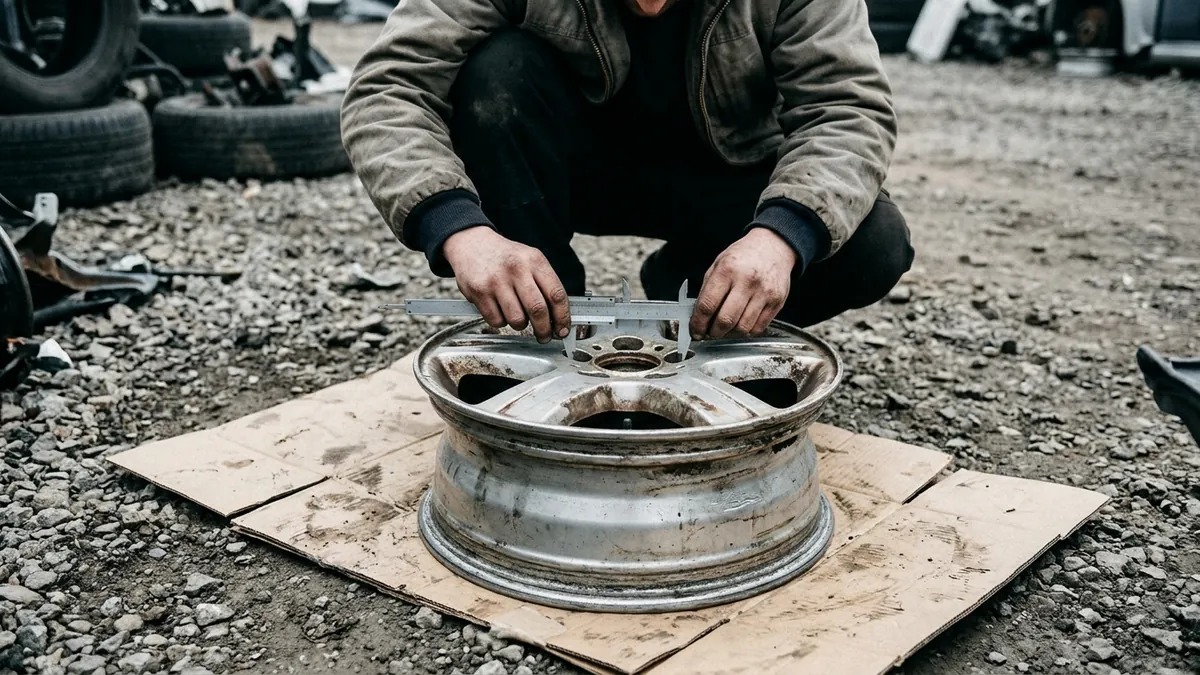
A wheel fits only when its bolt pattern, size, offset, and lug seat all match your vehicle. Discount Tire describes wheel size as four dimensions: diameter, width, bolt pattern, and offset. Miss one and you get anything from rubbing to a wheel that cannot be mounted safely.
- The bolt pattern is written as two numbers: the number of lug holes and the diameter of the circle they form. A 5x114.3 wheel has five lugs on a 114.3 mm circle. Discount Tire warns that the wrong pattern will not mount safely, so close is not good enough.
- Diameter is often stamped on the back of a spoke. Diameter and width both have to suit a tire size your vehicle maker approves.
- Offset is the distance in millimeters from the wheel's mounting surface to its centerline. It can be positive, zero, or negative. Get it wrong and the wheel and tire rub the brakes, fenders, or suspension.
- Lug nuts come with conical, ball (spherical), flat, and other seat shapes. If the nut seat doesn't match the wheel seat, the wheel may not be held securely.
- The center hole should sit snugly over your hub. A wheel from another vehicle with a larger center hole may need hub-centric rings; a tire shop can confirm.
The fastest way to confirm fitment before you pull
Pull wheels from the same make, model, and generation as your car, then verify with an interchange lookup. That takes out most of the guesswork, because factory wheels are engineered around the brakes, suspension, and load of their original vehicle.
- Decode your VIN. Our VIN lookup confirms model year, trim, and drivetrain, which often decide wheel size.
- Read your tire placard. Federal standard FMVSS 110 requires a placard, usually on the driver's door pillar, listing the original tire size and inflation pressure.
- Check interchange. Yards cross-reference wheels by Hollander number. Our Hollander interchange guide explains how to read those listings.
- Match the part number. Many factory wheels carry a part number on the back. Your dealer's parts counter can confirm whether it lists for your VIN.
Be careful moving wheels between a lighter and a heavier vehicle that share a bolt pattern. A wheel designed for a small car or a light-duty truck was not necessarily built for the load of a heavier model. If the part number does not list for your vehicle, do not assume it carries the same load.
What do used rims cost at a junkyard?
Self-service chains post flat prices by part type, so a wheel costs the same no matter what car it comes off. The table shows Pick Your Part's posted prices at two stores in October 2026. The core deposit is refundable when you return a matching old part, and the 90-Day Worry-Free Guarantee is optional.
| Part (Pick Your Part) | Tampa, FL price + core | Aurora, CO price + core | Optional 90-day guarantee |
|---|---|---|---|
| Wheel (aluminum) | $31.50 + $17.00 | $38.50 + $15.00 | $9.45 / $11.55 |
| Wheel (steel) | $18.50 + $2.00 | $25.00 + $1.00 | $5.55 / $7.50 |
| Tire, 16-18 inch | $23.50 | $34.00 | $7.05 / $10.20 |
Prices are as of October 2026, exclude tax, and vary by location. Check your own store's posted list before you go. Some yards also charge separately for tire dismounting.
Damage checks to do at the yard
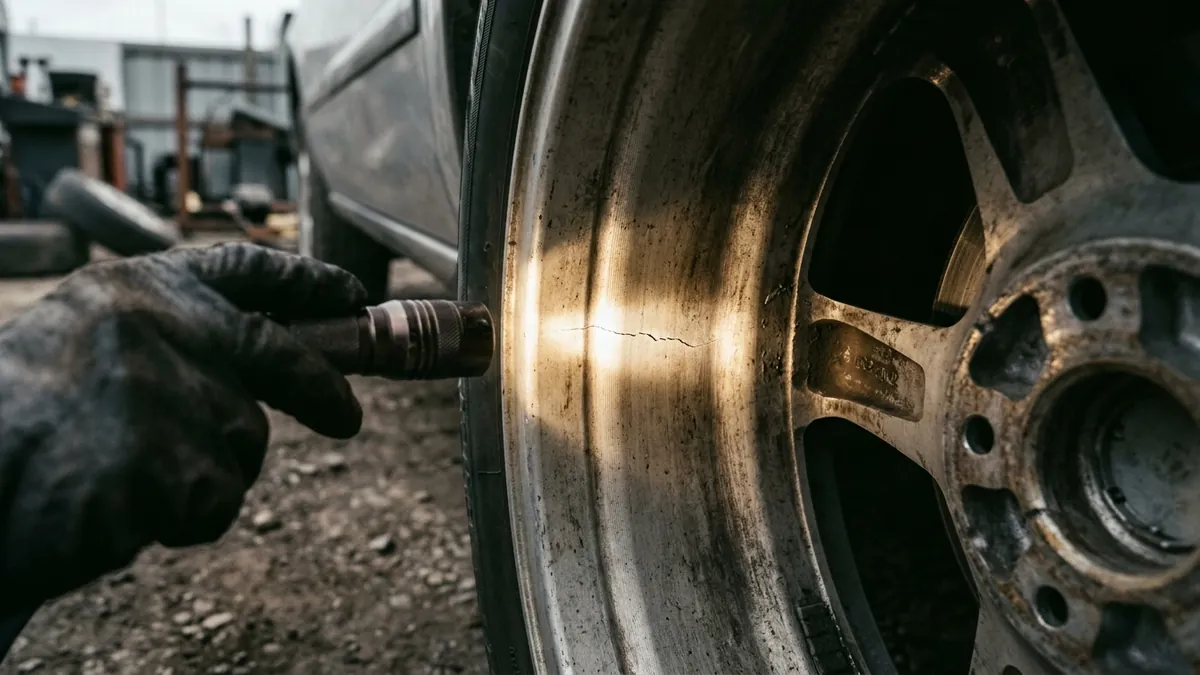
Cracks, bends, and old repairs kill most used-wheel deals, and you can spot them in five minutes with a flashlight and a rag. Clean the inner barrel first, because brake dust hides cracks.
- Look for cracks where each spoke meets the barrel, around the lug holes, and along the inner and outer lips. A crack in an aluminum wheel is a reject, full stop.
- Sight along the inner lip as you rotate the wheel. Flat spots or ripples usually come from potholes, and they show up later as a vibration or a slow leak.
- Uneven paint, grinding marks, or heat discoloration on the barrel point to an old weld or straightening job. You have no way of knowing how well it was done.
- Heavy pitting on the bead seat, where the tire seals against the rim, causes slow leaks. A tire shop can often clean up light corrosion.
- Elongated or damaged lug seats suggest the wheel was run loose.
- Curb rash on the outer face is usually cosmetic. Deep gouges into the lip are not.
If the yard allows it, check wheels while they are still on the donor. Some U-pull yards do not allow jacks, so read the yard rules first. Our list of tools for a salvage yard run covers what to pack, and our guide to pulling your own parts covers how yards stage cars.
Tires and TPMS sensors that come with the wheel
Tires on junkyard wheels are a bonus at best, and you should not plan to drive on them without a professional inspection. Pull-A-Part's price page states that tire carcasses it provides are deemed unfit for road use on a passenger vehicle, and that it makes no representation about tire usability.
Read the DOT code on the sidewall if you are considering the tires. Federal rule 49 CFR 574.5 makes the last four digits the date code: the first two give the week and the last two give the year of manufacture. A tire stamped 2419 was made in the 24th week of 2019. Age, cracking, and uneven wear all count against it.
Wheels from newer vehicles may also carry tire pressure monitoring sensors. FMVSS 138 phased in TPMS on new light vehicles, with the full requirement taking effect for vehicles made from September 1, 2007. Used sensors may have tired batteries or may not match your vehicle's system, so ask your tire shop whether they can be relearned or should be replaced.
When should you buy new wheels instead?
Buy new when you cannot find a straight, crack-free wheel with a part number that lists for your vehicle. A cheap wheel that is wrong costs more than a new one once you add mounting, balancing, and a second trip.
- The only available used wheels are cracked, bent, or show weld repairs.
- You need a full matched set and the yard only has one or two of your size.
- Your vehicle is a heavy-duty truck or tows near its limit and you cannot confirm the used wheel's part number.
- You are changing size or offset from stock. A tire shop should confirm clearance before you buy anything.
Warranty and return considerations
Wheel return windows are shorter than for most parts, so mount and balance quickly. Pull-A-Part's published policy gives tires and wheels a 3-day limited warranty for exchange or store credit with a receipt, compared with 30 days for most parts. Pick Your Part's optional 90-Day Worry-Free Guarantee covers returns with the original receipt when the part is marked at purchase.
Have the yard mark each wheel, keep the receipt, and book the tire shop before your trip. A balancing machine finds a bend faster than your eye does, and it finds it while you can still exchange the wheel. For more on which parts hold up well used, see our list of junkyard parts to buy and avoid.
How to find a yard near you
A search for "pick a part near me" is a good place to start for wheels, since self-service yards price them low. Search our directory of junkyards that sell parts for self-service and full-service yards near you, then check each yard's online inventory for your model and generation. If you are near the stores in our price table, browse yards in Florida and Colorado. Call ahead to confirm wheel prices and whether the yard lets you bring a jack.
Sources
- Discount Tire: Measure Wheel Bolt Pattern (accessed October 2026)
- Discount Tire: Wheel Size Basics (accessed October 2026)
- Discount Tire: Lug Nuts (accessed October 2026)
- Cornell LII: 49 CFR 571.110, Tire Selection and Rims (accessed October 2026)
- Cornell LII: 49 CFR 574.5, Tire Identification Requirements (accessed October 2026)
- Cornell LII: 49 CFR 571.138, Tire Pressure Monitoring Systems (accessed October 2026)
- Pick Your Part: Tampa Parts Prices (accessed October 2026)
- Pick Your Part: Aurora Parts Prices (accessed October 2026)
- Pull-A-Part: FAQs: Parts Return and Warranty Policy (accessed October 2026)
- Pull-A-Part: Used Auto Parts Price List (accessed October 2026)
- Pick Your Part: Sales Policies (accessed October 2026)