Can You Buy a Used Airbag? Federal Rules and Safer Options
Some salvage yards sell airbag modules and some refuse to. What federal and state law say, why recalled inflators make junkyard airbags risky, and the safer ways to restore an airbag system.
Key Takeaways
- Federal law bars repair businesses from knowingly making an airbag system inoperative (49 U.S.C. 30122). State rules on salvaged airbags vary.
- Honda says it removed over 100,000 recalled inflators from salvage yards after a 2017 fatal rupture involving a salvaged inflator.
- Some chains refuse to sell them. Pull-A-Part will not resell driver or front passenger airbags.
- The safest option is a new OEM airbag installed by a qualified technician. If you consider recycled, the donor VIN must be recall-free.
Sometimes, but a recycled airbag module is one of the riskiest parts in any salvage yard. Recalled inflators have turned up in salvaged parts, counterfeits circulate online, and state rules vary. The safer path is a new original-equipment airbag from a dealer, installed by a qualified technician. If you go recycled, verify the donor VIN is recall-free first.
Is it legal to buy a used airbag?
There is no single national answer, because federal law focuses on who disables safety equipment while states set most rules on salvaged airbags. Under 49 U.S.C. 30122, a manufacturer, distributor, dealer, rental company, or motor vehicle repair business may not knowingly make inoperative any safety device installed to meet a federal motor vehicle safety standard. Airbags fall in that category.
States take different approaches. Rhode Island's 2010 Automobile Airbag Fraud Prevention Act regulates salvaged airbags rather than banning them. Anyone in the business of buying, selling, or installing salvaged airbags must keep records that include the airbag's identification number and the VIN of the vehicle it came from. Sellers and installers must disclose that the airbag is salvaged, and the installer must give the owner an affidavit that it was properly installed. Records must be kept for at least five years.
Other states have their own airbag fraud laws, and some have considered restricting salvaged airbags. Check your state's current statutes, or ask a licensed collision shop what your state requires, before you buy.
Why are junkyard airbags risky?
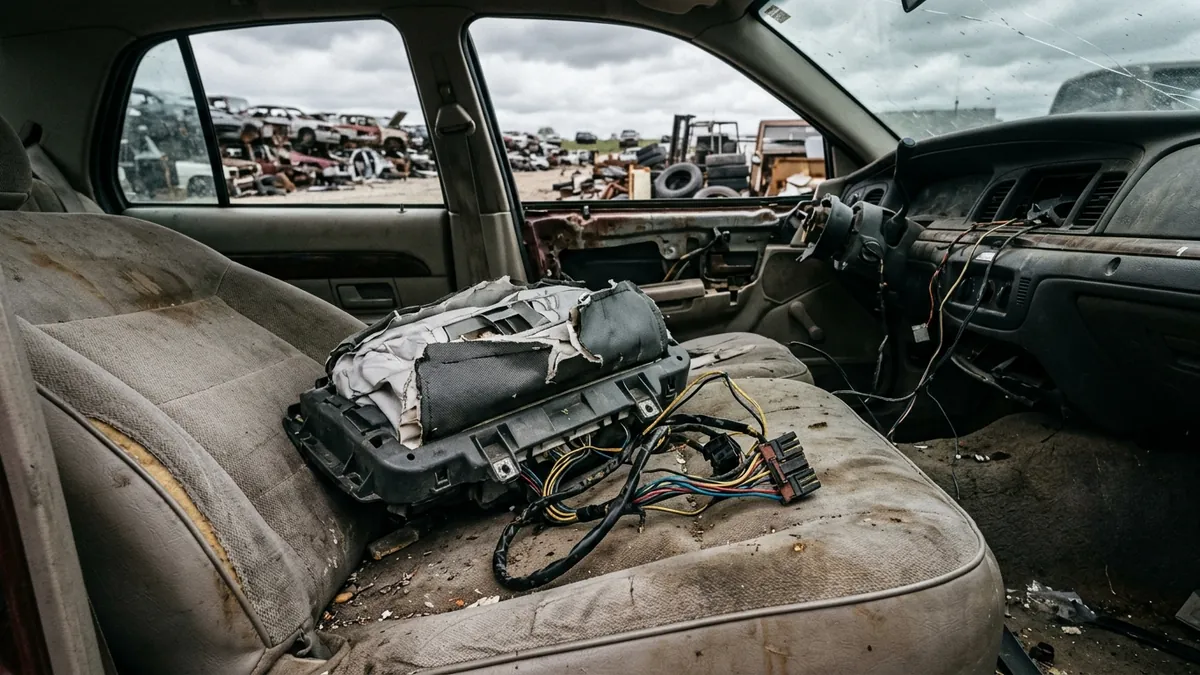
The biggest documented risk is a recalled inflator hiding in a salvaged module. In a December 19, 2017 statement, Honda reported that a recalled Takata driver's inflator ruptured in a 2004 Civic crash in Baton Rouge, and that the inflator was believed to be a salvaged part installed in that car at an unknown point. Honda said it had spent two years searching salvage yards nationwide and had removed over 100,000 recalled inflators. It also asked major online auction sites to stop selling affected airbags.
Counterfeits are the second risk. In October 2012 the Automotive Recyclers Association publicly supported NHTSA's warning to consumers about counterfeit airbags, while asking NHTSA to make clear that recycled, non-deployed original-equipment modules are not counterfeit. Our guide to spotting counterfeit auto parts covers the warning signs.
The third risk is hidden damage. A module from a flooded car, or one with cut wiring, may look fine and still not work when you need it.
Which yards sell airbags, and what do they cost?
Policies differ by chain, so check before you drive out. This is what two large self-service chains published as of October 2026.
| Chain | Airbag policy | Posted price (October 2026) |
|---|---|---|
| Pull-A-Part / U-Pull-&-Pay | Does not resell driver or front passenger airbags or related airbag components, except horn covers. Advises checking the donor's recall status at nhtsa.gov. | Not sold |
| Pick Your Part (LKQ) | Lists "air bag" on its posted price lists. All parts sold as-is unless the optional guarantee is purchased. | $54.50 (Tampa, FL); $72.00 (Aurora, CO) |
A low posted price does not make a used airbag a good deal. It reflects a flat self-service price for the part type, not any testing or recall screening of the specific module.
The same caution applies to the parts around the airbag. Pick Your Part's Tampa list, for example, also prices an "airbag sensor" ($41.50 before tax and the optional guarantee, as of October 2026), and front seats are listed separately with and without an airbag. Crash sensors tell the control module when to fire, so a used sensor deserves the same scrutiny as the airbag itself. A seat with a side airbag, a steering wheel with a driver module, or a dashboard with a passenger module all carry the same recall and damage questions as a loose airbag. If you are buying a seat or steering wheel for another reason, ask whether the yard removes the airbag first, and treat any airbag that comes with it as a separate decision.
Horn covers are the exception some U-pull yards make. Pull-A-Part says horn covers are the one airbag-related item it will still sell, which is useful if your cover is cracked or faded but the module behind it is fine.
How to confirm an airbag fits your vehicle
An airbag must be the exact part designed for your vehicle. Close doesn't count. Modules differ by model year, trim, seat type, and sometimes interior color, and a mismatch can trigger a warning light or deploy incorrectly.
- Decode your VIN with our VIN lookup to confirm model year, trim, and build details.
- Match the OE part number on the module label exactly. Interchange tools help you find donors, as our Hollander interchange guide explains, but for restraint parts the part number has the final word.
- Get the donor VIN and check it for open recalls at NHTSA. Our VIN parts guide explains why the donor VIN matters for airbag modules.
- Ask a dealer or the service manual what else must be replaced after a deployment. Depending on the vehicle, that can include seat belt pretensioners, crash sensors, the clock spring, or the airbag control module.
Inspection checklist if you are considering a recycled airbag
If you do consider a recycled module, reject anything you cannot fully document. A clean-looking cover proves nothing about the inflator inside.
- The donor VIN is available and recall-free. No VIN, no sale.
- It has never deployed. Torn or re-glued covers, scorch marks, or a module that feels light all say otherwise.
- The label is intact and legible, and the part number matches yours exactly.
- The connector and pigtail are undamaged. Cut, spliced, or corroded wiring is a reject.
- The donor has no flood or fire history. Water and heat can damage the inflator and electronics.
- A professional removed it. Airbag modules contain an explosive inflator, so pulling one yourself at a self-service yard is a safety risk. Check the yard's rules and leave restraint parts to a trained technician.
When should you buy a new airbag instead?
For most drivers, the answer is always. A new original-equipment airbag from the vehicle maker's dealer has no recall history, no unknown prior damage, and a clear supply chain. That is the option our list of junkyard parts to buy and avoid recommends too.
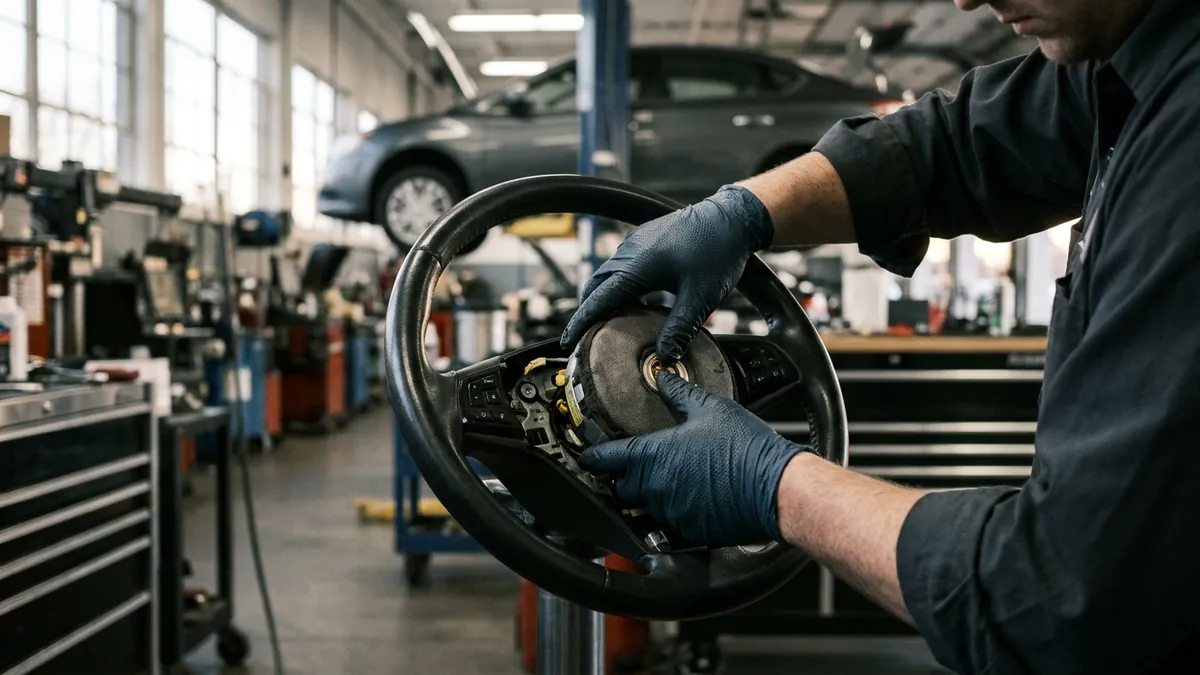
If cost forces a recycled option, the safer route is a full-service recycler that documents the donor VIN and part number and supports its parts, rather than a module you pull yourself. The Automotive Recyclers Association has promoted an airbag protocol in which trained technicians handle recycled airbags, match them to the vehicle by VIN, and supply a certificate that a state agency can use to verify compliance. Ask any recycler whether it follows a documented process like that.
Either way, have a qualified collision or dealer technician install it. After installation, the airbag warning light should come on at startup and then go out as part of its normal self-check.
Warranty and return considerations
Expect little protection on a used airbag. Pick Your Part's sales policy states that its parts are sold as-is and that it makes no warranty of fitness or merchantability, apart from its optional 90-Day Worry-Free Guarantee and certain batteries. A return policy covers the money you spent, not the consequences of an airbag that fails in a crash.
Insurance can change the math. If the airbags deployed in a covered crash, ask your insurer what it pays for and whether it specifies new or recycled restraint parts before you buy anything yourself.
How to find a yard near you
A search for "used auto parts near me" turns up self-service and full-service yards alike, and for airbags you want the second kind. Use our junkyard directory to find full-service auto recyclers that pull and document parts for you, then call and ask directly about their airbag policy and whether they check donor recalls. For the airbag itself, a dealer parts department is the safest call you can make.
This is general information, not legal advice. Rules change; confirm with your state motor vehicle agency or NHTSA before you buy or install an airbag.
Sources
- Cornell LII: 49 U.S. Code § 30122, Making safety devices and elements inoperative (accessed October 2026)
- Rhode Island General Assembly: R.I. Gen. Laws § 31-53-5, Airbag antitheft (accessed October 2026)
- American Honda via NHTSA: Statement re: Confirmed Rupture of Takata Airbag Inflator in Baton Rouge, LA (December 2017) (accessed October 2026)
- NHTSA: Check for Recalls by VIN (accessed October 2026)
- Automotive Recyclers Association: ARA Joins NHTSA in Warning Vehicle Owners About Counterfeit Air Bags (October 2012) (accessed October 2026)
- Pull-A-Part: Used Auto Parts Price List (accessed October 2026)
- Pick Your Part: Tampa Parts Prices (accessed October 2026)
- Pick Your Part: Aurora Parts Prices (accessed October 2026)
- Pick Your Part: Sales Policies (accessed October 2026)