Junkyards, Salvage Yards, and Wrecking Yards: What's the Difference and How to Choose
Three names, one industry — but the wording tells you something about what a yard actually does. Here is how the terms differ, what the four yard types are, and which one fits the job in front of you.
Key Takeaways
- Junkyard, salvage yard, and wrecking yard describe the same licensed business — the difference is regional wording and emphasis, not legal category.
- Wrecking yard is the standard term across the western US, Australia, and New Zealand; searching only one phrase hides yards from your results.
- The auto recycling industry runs more than 9,000 locations in the United States and generates $32 billion in annual sales, according to the Automotive Recyclers Association.
- Self-service yards charge a $2-$5 entry fee and run 30-60% cheaper than full-service, but you supply the tools and the labor.
Junkyard, salvage yard, wrecking yard: is there a real difference?
No. All three names describe a business that buys end-of-life vehicles, resells the usable parts, and sends the remaining shell to a shredder. No US state licenses them as separate categories — the license is usually written as auto dismantler, vehicle recycler, or salvage dealer regardless of the sign out front.
What does change is where the word is used and what the owner wants you to think about the operation. That matters for one practical reason: search engines match business names. If you only type one phrase, you only see part of the market.
Wrecking yard
Wrecking yard is the dominant term in California, Oregon, Washington, Nevada, and Arizona, and it is the default across Australia and New Zealand, where the trade calls itself auto wrecking. The word comes from wrecked vehicles arriving after collisions, not from anything the yard does to the car. A business named Pacific Auto Wrecking is doing exactly what a business named Eastside Salvage does in Pennsylvania.
If you are searching wrecking yards near me and getting thin results, you are probably east of the Rockies where yards simply do not name themselves that way. Swap the term and the map fills in.
Salvage yard
Salvage yard carries an implication that the business resells parts rather than crushing cars for metal weight. Yards that inventory their stock, photograph parts, and quote over the phone tend to pick this name. It is also the term insurers and DMVs use, which is why salvage title appears on paperwork in all 50 states.
Junkyard
Junkyard is the oldest of the three and the one the industry likes least. It suggests scrap: cars stacked for weight, sold by the ton, with parts as an afterthought. Some yards genuinely operate that way and will tell you on the phone that they only sell what is still bolted to whatever came in last week. Others use the name because customers search for it.
Do not read too much into any of it. Ask what the yard actually stocks instead of guessing from the sign.
What the industry calls itself
Inside the trade, the terms are auto recycler and dismantler. According to the Automotive Recyclers Association, the industry operates more than 9,000 locations in the United States, employs over 140,000 people, and generates $32 billion in annual sales. Its members process vehicles under environmental rules the EPA enforces for fluid capture, refrigerant recovery, and mercury switch removal. A yard that describes itself as a certified auto recycler is telling you it handles fluids and hazardous components to standard, which is a fair signal of how the rest of the operation runs.
The scale matters to you as a buyer. Roughly 95% of vehicles retired from use in the United States get recycled in some form, and about 86% of a vehicle's material content is reused, recycled, or recovered for energy. That is why a part for a 12-year-old sedan is almost always sitting on a shelf somewhere.
The four types of yards you will encounter
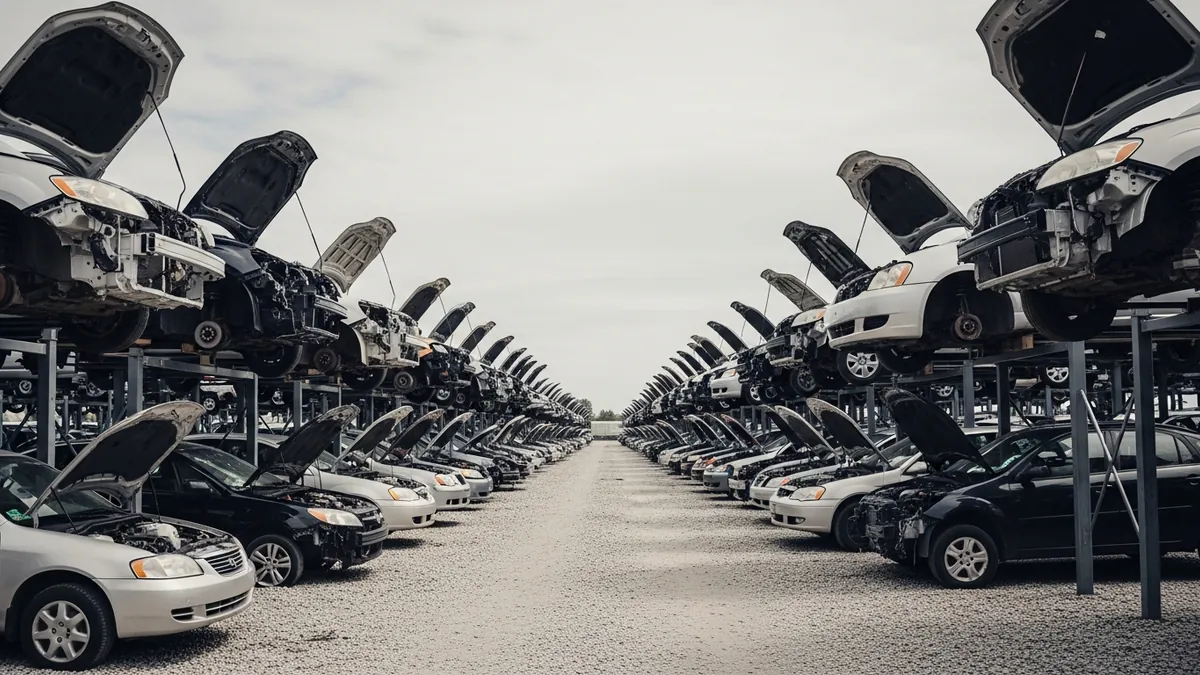
Yards sort into four operating models: self-service, full-service, specialty, and wholesale. The model determines your price, whether you touch a wrench, and whether you get a warranty. It has nothing to do with whether the sign says wrecking, salvage, or junk.
| Yard type | Who pulls the part | Typical cost | Warranty |
|---|---|---|---|
| Self-service (U-Pull-It) | You do, with your own tools | $2-$5 entry, 30-60% below full-service | Rare, often none |
| Full-service (dismantler) | Yard staff pull and test it | Highest of the four, still well under new OEM | 30-90 days standard; LKQ offers 6 months |
| Specialty | Yard staff, one brand or era only | Premium for scarce parts | Varies, often 30 days |
| Wholesale / core buyer | Not open to walk-in retail | Trade pricing, account required | Per contract |
Self-service, or U-Pull-It
You pay $2-$5 at the gate in 2026, walk rows of vehicles set on wheels or stands, and remove what you need yourself. Pricing is by part type from a posted list — an alternator costs the same whether it came out of a Corolla or a Tahoe. Expect 30-60% savings against full-service.
Bring a socket set covering 8mm through 19mm, which handles about 90% of the fasteners on a passenger vehicle, plus breaker bar, penetrating oil, wire cutters, and a headlamp. Most yards ban jacks, torches, and anything powered by a generator. Check the rules page before you load the car.
Full-service, or dismantler
You call with year, make, model, and the part. Staff check inventory, quote you, pull the part, and hold it at the counter. Many of these yards test electrical components and record engine mileage from the donor vehicle at intake. Warranties run 30-90 days as a rule, and LKQ, the largest operator in North America, offers 6 months on many parts.
Ask the yard whether the engine was running when the vehicle arrived. A dismantler that keeps intake notes will answer straight away. One that hesitates is guessing, and you should price the part accordingly.
Specialty yards
These stock a single make, a single era, or a single class of vehicle — European only, diesel trucks only, pre-1975 domestics only. They are the answer when a general yard says nobody has one. Prices are higher because scarcity is the product, and staff usually know the platform well enough to tell you which model years interchange.
Wholesale and core buyers
These sell to repair shops, rebuilders, and other yards rather than the public. You will run into them when a search result has no retail hours listed and the phone menu asks for an account number. Some will sell retail if you ask directly. Most will refer you to a partner yard.
How to find a wrecking yard near you
Search all four terms, not one. Wrecking yard, salvage yard, junkyard, and auto dismantler each return a partly different list because yards are indexed under the name on their business registration. In most metro areas, each phrase surfaces three to eight yards the others miss entirely.
Start with a state-by-state directory that already normalizes those names into one list, then cross-check against maps. If you know the exact part and vehicle, search live inventory on Car-Part.com, which most mid-size and large dismantlers feed daily. That tells you which yard has your donor vehicle before you spend a Saturday driving.
What to check before you go
- Recent reviews — read the last six months only. Yards change hands and inventory turns over; a 2023 review tells you nothing about today's rows.
- Inventory refresh rate — self-service yards that post a new-arrivals list weekly are cycling stock. A list untouched for two months means picked-over cars.
- Stated hours and last entry — many yards stop admitting customers 45 to 60 minutes before closing so the rows clear on time.
- Payment and return terms — some self-service yards are cash only, and some charge a core deposit on top of the part price.
The phone call that saves the drive
Two minutes on the phone prevents most wasted trips. Self-service yards will not hold parts, but they will tell you whether the car is still on the lot and roughly when it landed. Ask these, in this order:
- Is the vehicle still in the yard — and what row. Cars get crushed on a rotation, and a listing can outlive the car by a week.
- When did it arrive — a car that came in yesterday still has its alternator. One that has sat 90 days in a busy yard has been picked clean of anything common.
- Was it running when it came in — the single most useful question for engines, transmissions, and anything electrical. Yards that log intake condition answer instantly.
- What is the price on that part — self-service yards quote from a fixed list, so you can get the number before you leave the house.
- What happens if it does not work — get the return window and whether it is refund or store credit, and ask whether they will put that in writing on the receipt.
If the person on the phone will not check the lot and tells you to just come look, treat that as information about how the yard is run. It is not disqualifying at a self-service operation. At a full-service dismantler quoting you $600 for an engine, it is.
Verify the vehicle, not just the model
Two cars with the same badge can carry different parts. Use the VIN to confirm engine and trim before you commit: the 8th digit of a US-market VIN is the engine code. Run the donor VIN through a free VIN decoder and compare it against yours. For mechanical parts, ask the yard for the Hollander Interchange number, which tells you every other vehicle that carries the identical component. Casting numbers stamped into engine blocks and cylinder heads settle any remaining doubt.

What to expect on your first visit
At a self-service yard you sign a liability waiver, pay the $2-$5 entry fee, and walk in. Nobody will help you find the car. Rows are usually grouped by make or by domestic and import, and a printed or on-screen row map sits by the entrance.
Wear boots and long pants. Yards are gravel, mud, and sharp sheet metal. Bring water in summer — a row of cars in an open lot runs hotter than the parking lot you left. Cars sit on their own wheels or on stands, and reaching under one is where people get hurt.
Safety rules that are not optional
- Lifting — use rated jack stands, never a jack alone, and never crawl under a vehicle supported by anything the yard stacked up for you.
- Airbags and SRS — disconnect the negative battery terminal and wait 15 minutes before touching anything in the system, and never probe the yellow SRS connectors. Stored charge fires modules after the battery is gone.
- Hybrid and EV vehicles — orange cables carry 300-800V DC. This is not DIY work. Leave the pack, inverter, and cabling to trained technicians.
- Fuel system — relieve fuel pressure before opening a line, work in open air, and keep a Class B extinguisher within reach. Gasoline that has sat in a tank for months still ignites.
- Cooling system — never open a hot radiator or reservoir. Wait a full hour after the engine has been run.
OSHA has documented the airbag hazard directly: untrained workers dismantling vehicles can cause a bag to deploy, exposing them to sodium azide, and undeployed modules can explode under shredder heat. The EPA classifies undeployed airbag inflators as reactive and ignitable hazardous waste under RCRA when discarded. Never place an intact undeployed airbag face down on a solid surface — if it fires, it launches.
How to choose the right yard for your job
Match the yard type to the part and to how much your time is worth. A $40 savings on a mirror is not worth four hours if you bill your Saturday at anything.
- Body panels, mirrors, glass, interior trim — self-service. These are bolt-off items, damage is visible, and the price gap is largest here.
- Engines, transmissions, transfer cases, differentials — full-service. You want mileage records, an intake note on whether it ran, and a 30-90 day warranty behind it.
- Alternators, starters, AC compressors, window motors — either, but full-service if the yard bench-tests. A tested alternator at double the U-Pull price is still cheaper than pulling the job twice.
- Anything for a car older than 1990 or sold in small numbers — specialty yard. General yards crush what does not sell, and low-volume platforms sell slowly.
Parts to buy new, every time
Five categories are not worth any discount: brake pads and rotors, tires, airbags and SRS components, timing and serpentine belts, and fuel system components including pumps and injectors. Each is either a wear item whose remaining life you cannot measure or a safety device whose service history you cannot verify. Walk away from a yard that pushes any of them on you.
When you are the one selling
The same yards that sell you parts buy vehicles. What you get depends on scrap metal weight, the value of intact premium components such as the catalytic converter and engine, and whether the yard needs your model on the lot. Get three quotes, and have the title, your ID, and both keys ready. Our guide to selling a junk car covers the paperwork state by state, and the main site lists yards that buy in your area.
The vocabulary that gets you taken seriously
Yard staff move faster when you use their words. Six terms cover most counter conversations.
- Donor vehicle — the specific car your part comes off. Always ask for its year, trim, and mileage.
- Dismantler — the licensed operator, and the legal term in most states for a full-service yard.
- Hollander Interchange — the industry numbering system that maps which parts fit which vehicles across makes and model years.
- Casting number — the number cast into a block, head, or housing that identifies the exact component variant.
- Core charge — a refundable deposit you get back when you return your old unit.
- ARA damage codes and grades — the Automotive Recyclers Association scale for body and mechanical parts. Damage is counted in units, where one unit is an area a credit card would cover. Grade A is 0.0 to 1.0 units, Grade B is 1.1 to 2.0, and Grade C is 2.1 or more. A damage code of 000 means no damage at all.
One last thing worth saying plainly: the name on the gate predicts almost nothing. A yard called Bob's Junk in rural Ohio may keep better intake records than a polished operation two states over. Judge the yard on inventory turnover, whether staff answer specific questions without stalling, and what they put in writing about returns.