What Happens to Your Car After You Sell It to a Junkyard
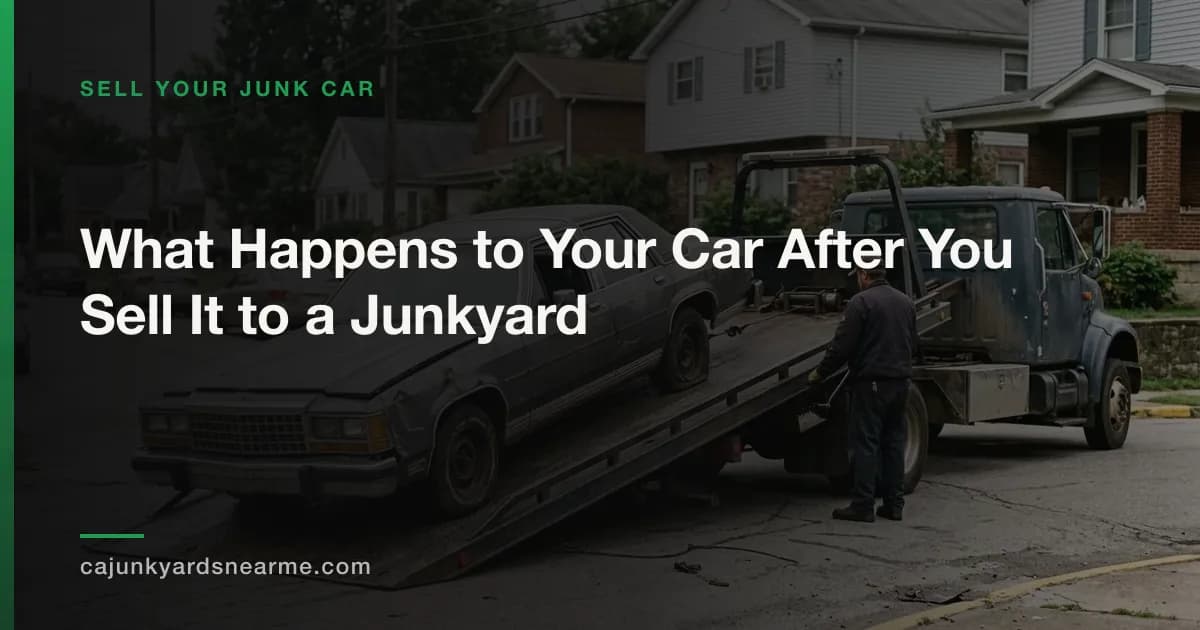
Flattening comes late in the process. First your old car is reported to a federal database, drained, and stripped of reusable parts; then it is shredded into metal that goes back to the mills.
Key Takeaways
- Licensed yards report each junk or salvage car's VIN to the federal NMVTIS database, at least monthly.
- Before a car is crushed, the yard drains the fluids, pulls the battery, and must make sure the A/C refrigerant is recovered under EPA rules.
- The Automotive Recyclers Association says about 86 percent of a vehicle's material content is recycled, reused, or used for energy recovery.
- The leftover shredder residue is roughly 25 percent of vehicle weight, according to an Argonne National Laboratory report, and typically goes to landfill.
After you sell a car to a junkyard, it is logged and reported to a federal title database, then drained of fluids and hazardous parts. Reusable parts are pulled and sold, either by the yard or by customers in a self-service lot. The stripped shell is flattened and shredded, and the metal goes to steel mills and other buyers. Only the residue that cannot be recovered is landfilled.
Step 1: the yard records the car and reports the VIN
The first thing a licensed yard does is document the vehicle. Under federal law, auto recyclers, junkyards, and salvage yards are required to report vehicles they take in to the National Motor Vehicle Title Information System (NMVTIS), run by the U.S. Department of Justice. Yards that handle fewer than five junk or salvage vehicles a year are exempt.
According to the NMVTIS program, each report includes the yard's name and contact information, the VIN, the date the vehicle was obtained, who it came from (visible only to law enforcement and government agencies), and whether the car was crushed, disposed of, offered for sale, or is intended for export. Reports are due at least monthly.
That record stays with the car after you are out of the picture. NMVTIS lists any report of a vehicle being transferred to an auto recycler, junkyard, or salvage yard, and once a state brands a car as junk or salvage, the brand becomes a permanent part of its NMVTIS record. This is the main reason a licensed yard insists on your title and ID: its reporting has to match the paperwork.
Step 2: depollution, or draining everything that can leak
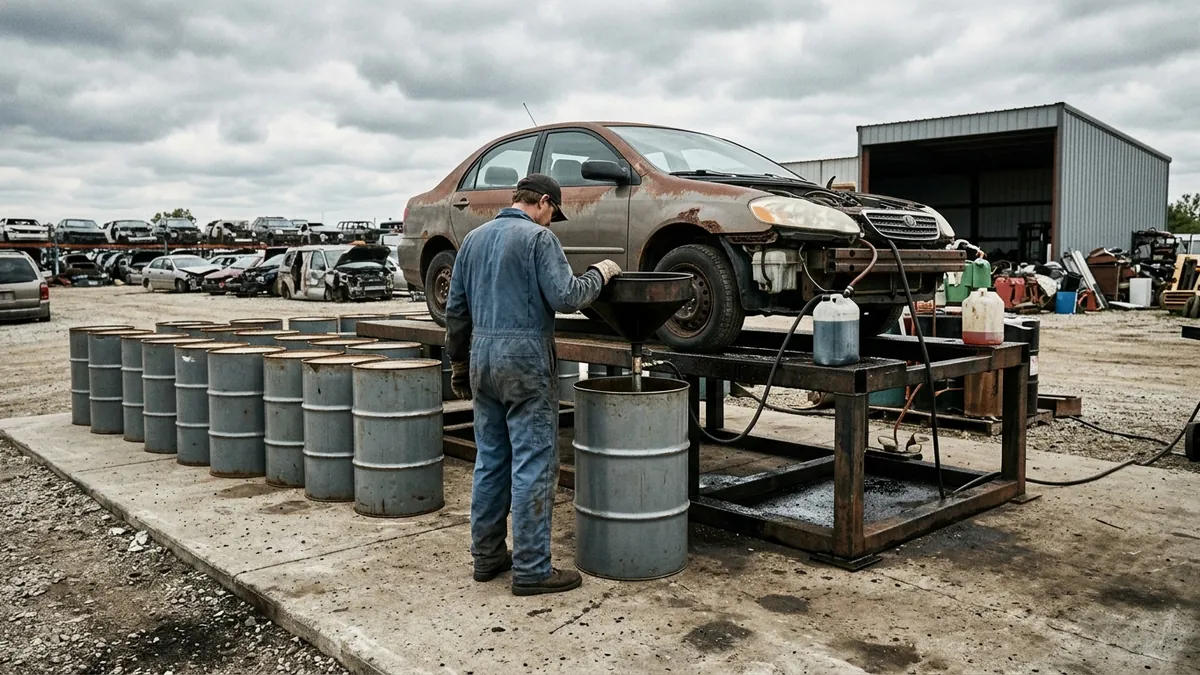
Before a car is stored, stripped, or crushed, the yard takes out the fluids and components that would contaminate soil, water, or the metal stream. This usually happens soon after intake.
- Fuel, oil, coolant, and washer fluid get drained. The ARA estimates the industry collects and reuses or recycles about 8 million gallons of gasoline and diesel, 24 million gallons of motor oil, 8 million gallons of engine coolant, and 5 million gallons of washer fluid each year.
- The lead-acid battery is pulled and sent for recycling. The ARA says the industry recycles 96 percent of all lead-acid batteries.
- Air conditioning refrigerant cannot be vented; EPA rules prohibit it, and disposal of motor vehicle air conditioners falls under Section 608 of the Clean Air Act. Under EPA's safe disposal rules, the final person in the disposal chain, such as a scrap metal recycler, is responsible for making sure the refrigerant is recovered, or for keeping a signed statement that it was recovered earlier.
- Some older vehicles have mercury switches in the hood and trunk convenience lights. New York's environmental agency, for example, says these switches must be removed by dismantlers or shredders before crushing or shredding, and points to domestic cars built before model year 2003 and foreign cars built before model year 1992. EPA's National Vehicle Mercury Switch Recovery Program reported that participants had removed more than 994,000 switches after collection began in August 2006.
- Tires are pulled for reuse or recycling. The catalytic converter is usually cut off early, too, because its precious metals make it one of the most valuable parts on the car. Our catalytic converter value guide covers why.
Step 3: the reusable parts get sold
Parts are where a recycler makes much of its money, and they are why your car is often worth more to a yard than its scrap weight. What happens next depends on the type of yard.
| Yard type | What happens to your car's parts | Who does the removing |
|---|---|---|
| Full-service recycler | High-demand parts (engine, transmission, doors, lights, modules) are pulled, tested, inventoried, and sold, often with a warranty | Yard staff |
| Self-service (U-pull) yard | The drained car is set on stands in the lot for a period, and customers remove what they need | Customers with their own tools |
| Scrap processor | Little or no parts resale; the car moves quickly to crushing and shredding | Not applicable |
A full-service yard is selective and pulls the parts it can sell. A self-service yard lets customers decide what is worth pulling. Our comparison of U-pull-it and full-service junkyards explains how each model prices parts.
Whole cars can leave this way too. A repairable vehicle may be resold rather than dismantled, and the NMVTIS report includes whether a car was offered for sale or intended for export. Your release of liability is what separates you from whatever happens to it next.
Step 4: crushing and shredding
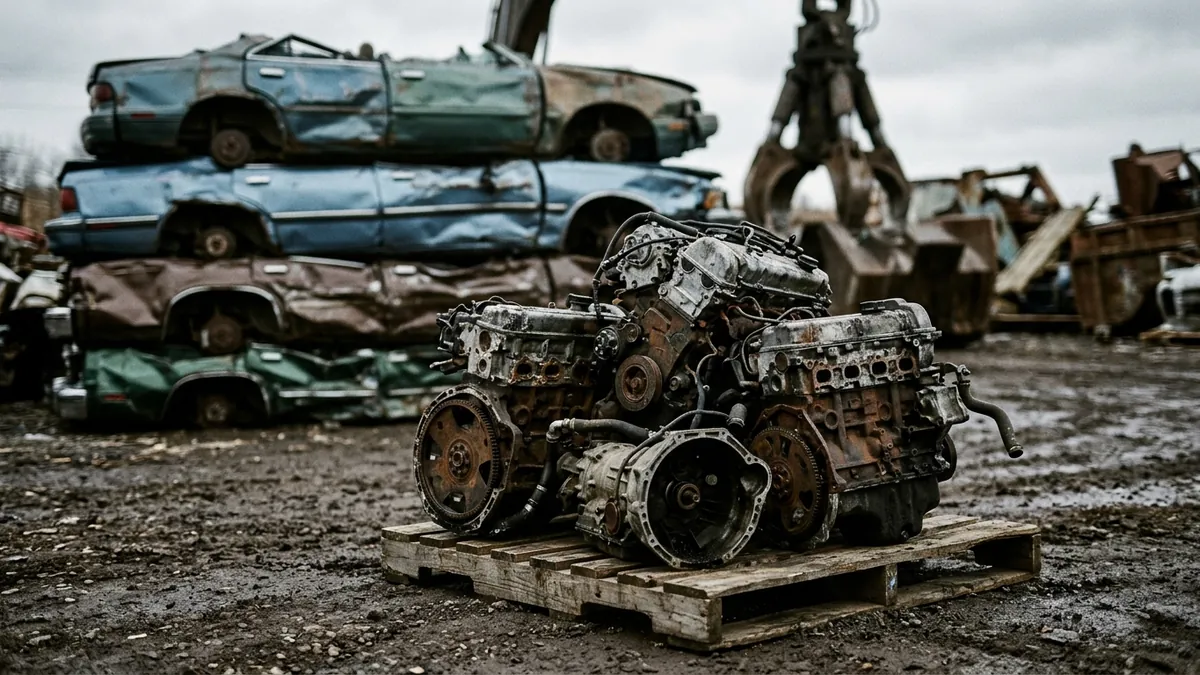
Once the saleable parts are gone, what is left (the hulk) is flattened so more of them fit on a truck. The flattened hulks go to a shredder, a large hammer mill that tears each one into small pieces.
Then the pieces are sorted. Magnets pull out iron and steel. Argonne's report notes that retired cars are the largest source of recycled ferrous scrap for the iron and steel industry. Other systems recover aluminum, copper, and other nonferrous metals. The remainder is shredder residue: plastics, foam, fabric, glass, rubber, and dirt. An Argonne National Laboratory report for the U.S. Department of Energy described this residue as about 25 percent of the weight of the vehicle and noted that it is typically sent to landfills.
How much of a junk car actually gets recycled?
Most of it, though the exact figure depends on what you count. The Automotive Recyclers Association says approximately 86 percent of a vehicle's material content is recycled, reused, or used for energy recovery. The same Argonne report said about 75 percent of automotive materials are profitably recycled through parts reuse, remanufacturing, and scrap processing, and that more than 95 percent of vehicles reaching end of life enter a recycling infrastructure.
It is a big industry. The ARA says the professional automotive recycling industry recycles over 4 million vehicles a year in the United States and Canada, operates at more than 9,000 locations, and employs over 140,000 people in the U.S. It also says each ton of new steel made from scrap saves 2,500 pounds of iron ore, 1,400 pounds of coal, and 120 pounds of limestone.
What this means for what you get paid
Everything above shows up in the price a yard offers. The metal sets a floor, so offers rise and fall with scrap prices from month to month. Parts set the ceiling: a complete car with a factory converter and a good engine earns more than a stripped shell of the same weight. Depollution and towing are costs the yard has already subtracted.
If you want the numbers, our guide to scrap car prices by weight shows how the floor is calculated, and what your junk car is worth in 2026 covers how parts and paperwork move the offer. Selling a car you cannot start? See how to sell a junk car without keys.
What you should do before and after the car leaves
Your part in this process is short. Skip it, though, and you get most of the post-sale headaches.
- Empty the car. Check the glove box, trunk, under the seats, and the spare tire well. Take out toll transponders and garage door remotes.
- Leave the fluids in. Draining them is the yard's job, and if you do it you are stuck disposing of them properly. Never vent the A/C.
- Sign the title correctly and keep a bill of sale with the VIN, date, and price.
- Deal with the plates the way your state requires. In Texas, sellers have the option to remove their plates and registration sticker.
- File your release of liability. California requires the Notice of Transfer and Release of Liability within 5 days of the sale. Texas recommends a Vehicle Transfer Notification within 30 days.
This is general information, not legal advice. Rules change; confirm with your state motor vehicle agency before you sell.
How to find a licensed yard near you
When a "junkyards that buy cars near me" search turns up a long list, start with the licensed yards: they are the ones that follow the reporting and disposal steps described here. Browse yards and recyclers by state in our directory of junkyards and salvage yards, then call two or three and ask how they handle intake, whether they pay by check or electronically, and what paperwork they need. To compare offers without making the calls yourself, request quotes for your car.
Sources
- Automotive Recyclers Association: Industry Statistics (accessed October 2026)
- U.S. Department of Justice, NMVTIS: NMVTIS Reporting Entities (accessed October 2026)
- U.S. Department of Justice, NMVTIS: For Consumers (accessed October 2026)
- U.S. EPA: Stationary Refrigeration Safe Disposal Requirements (accessed October 2026)
- U.S. EPA: Section 608 and Section 609 Overlap (accessed October 2026)
- U.S. EPA (archive): National Vehicle Mercury Switch Recovery Program (accessed October 2026)
- New York State DEC: Mercury Switch Management Guidance for Vehicle Dismantlers (accessed October 2026)
- Argonne National Laboratory via OSTI: End-of-Life Vehicle Recycling: State of the Art of Resource Recovery from Shredder Residue (accessed October 2026)
- California DMV: Title Transfers and Changes (accessed October 2026)
- Texas Department of Motor Vehicles: Buying or Selling a Vehicle (accessed October 2026)