U-Pull-It vs Full-Service Junkyard: Which One Should You Use?
Self-service yards run 30-60% cheaper, but you supply the tools, the labor, and the risk. Here is how to route each part to the right kind of yard.
Key Takeaways
- Self-service yards charge a $2-$5 entry fee and run 30-60% cheaper than full-service on the same part.
- Full-service yards warranty parts 30-90 days, and LKQ goes to 6 months. Self-service is usually sold as-is.
- The cutoff is labor, not price: bolt-on parts under an hour go self-service, anything needing a hoist or a test bench goes full-service.
- Cars are crushed after 30-90 days on a self-service lot, so a car you spotted last month may already be gone.
Which one saves you more money?
Self-service saves you more on the sticker, running 30-60% below full-service pricing for the same component, on top of a $2-$5 entry fee. Whether it saves you more in total depends on how long the part takes to remove and whether you can afford for it to fail.
Both models pull from the same pool. A used OEM part typically lands at 20-50% of the new dealer price no matter which door you walk through. The difference is who does the work and who carries the risk.
How a self-service yard works, end to end
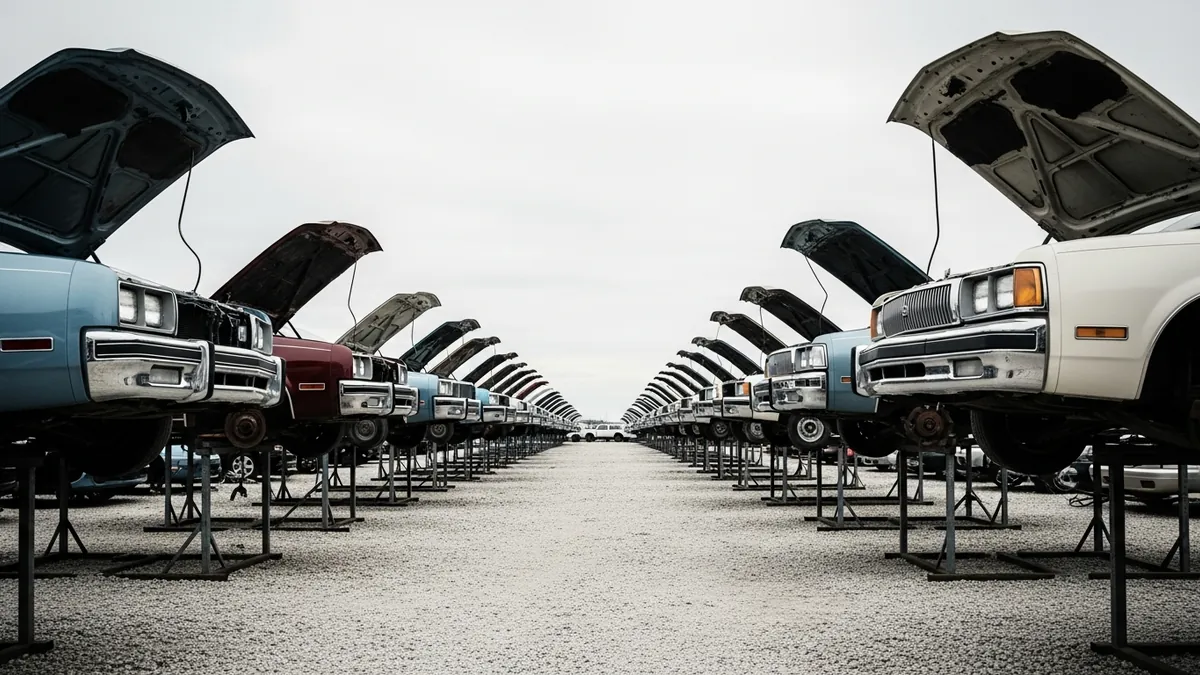
You pay at the gate, walk the rows, and remove the part with your own tools. Nobody helps you find the car, nobody pulls the part, and nobody tests it before you pay.
- Check inventory first. Most chains post a searchable yard inventory online with a row number and a set date, so call or search before you drive. While you have someone on the phone, confirm the real hours and the last-entry cutoff, which often closes an hour before the gate does.
- Pay the entry fee. $2-$5 at the counter, cash at some yards, and you sign a liability waiver.
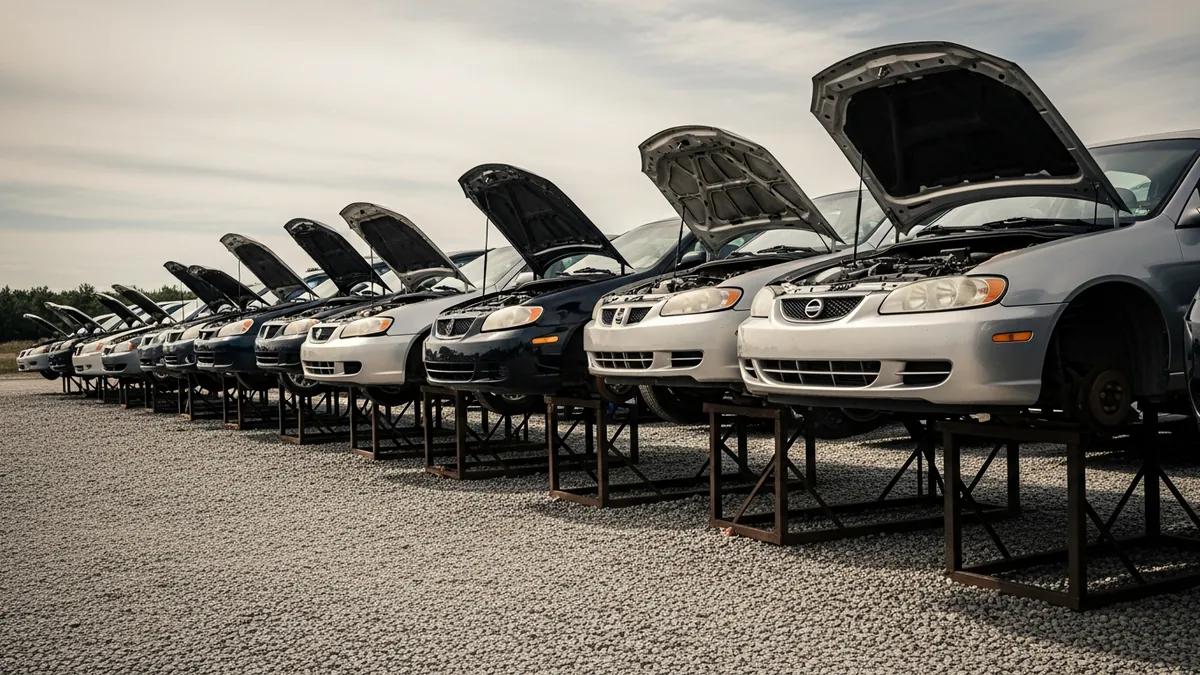
- Walk to the row. Cars sit on stands or wheels sorted by make, usually with the drivetrain fluids already drained.
- Pull the part. A socket set covering 8mm-19mm handles about 90% of the fasteners on the car. Penetrating oil and a breaker bar handle the rest.
- Pay flat rate at checkout. Pricing is by part category, not by vehicle, so an alternator off a BMW costs the same as one off a Corolla.
That flat-rate board is the quiet advantage of self-service. Luxury and low-volume vehicles are priced identically to economy cars, which is why people who drive German sedans learn the local U-Pull-It lot fast.
How a full-service yard works, end to end
You describe the part, a counter person searches a networked inventory database, and a yard employee pulls, cleans, and usually tests it before it reaches you. Car-Part.com alone indexes 150-250 million parts from roughly 3,100 recyclers, so a full-service yard can source from across the country rather than only from what is in its own gravel.
Parts arrive graded. Under ARA grading, damage is counted in units where one unit equals the area a credit card covers: Grade A is 0.0-1.0 units, Grade B is 1.1-2.0, Grade C is 2.1 or more, and damage code 000 means no damage. You can buy a body panel over the phone and know what you are getting. Expect a core charge of $5-$100 on components like alternators, starters, and calipers, refunded when you return the old unit.
What the price gap actually looks like
The gap widens as the part gets heavier and harder to remove, because that is where the labor content lives. A mirror is nearly the same price at both. An engine is not.
| Factor | Self-service (U-Pull-It) | Full-service |
|---|---|---|
| Entry cost | $2-$5 per person | None |
| Part pricing | 30-60% below full-service, flat rate by category | Priced per vehicle, year, and grade |
| Who removes the part | You, with your own tools | Yard staff |
| Warranty | Usually as-is; some yards sell a short exchange add-on | 30-90 days standard; LKQ 6 months |
| Testing before sale | None, you inspect it yourself | Common on electrical and drivetrain |
| Shipping | No, in person only | Yes, nationwide through recycler networks |
| Time on the lot | Cars crushed after 30-90 days | Inventory held until sold |
Warranty is the real dividing line
Full-service yards warranty parts for 30-90 days, and LKQ extends to 6 months on many components. Self-service sells as-is, which means a dead alternator is your dead alternator.
Run the math against the part, not against the discount. Save 50% on a $30 window regulator and the worst case costs you $30 and a second Saturday. Save 50% on a transmission and the worst case is a failed unit already bolted into your car with a weekend of labor on top of it. That is the case where a 90-day warranty is cheaper than the savings.
What your time is worth
Price the job in hours before you price it in dollars. A door mirror is 15 minutes. A rear axle assembly on a rusted truck is most of a day, and rusted bolts are the number one time-waster in any yard.
If a part takes you three hours to pull and saves $60 over full-service, you worked for $20 an hour in the rain with no warranty. Some people happily take that trade because they like the hunt and the tool practice. Fine. Just make it a decision instead of a default. And confirm fitment before you spend the morning: a part that bolts on physically may still be wrong electronically, which is what the Hollander interchange system exists to sort out.
Part by part: which yard to use
- Body panels, doors, hoods, bumpers — self-service. Bolt-on, easy to inspect for damage in daylight, and the flat-rate board saves the most here.
- Mirrors, handles, trim, interior panels — self-service. Minutes of work, and full-service labor charges swamp the part value.
- Wheels and seats — self-service. Bulky but simple, and you can check curb rash and upholstery yourself.
- Alternators, starters, AC compressors — either. Self-service if you can bench-test or accept the risk, full-service if you want it tested and warrantied.
- Engines and transmissions — full-service. You need a hoist, and you need the warranty. Do not attempt these on a self-service lot.
- ECUs, modules, instrument clusters — full-service. Many require programming and a matching part number, and a dead one is unprovable at a U-Pull-It counter.
- Radiators, condensers, cooling components — either, with the yard car cold before you touch anything.
- Brake pads, rotors, tires, belts, fuel pumps, injectors, airbags and SRS parts — neither. Buy these new. Counterfeit airbags are a documented problem in the US, and a used fuel pump or belt is a roadside failure waiting for a schedule.
If you are still choosing, the deeper walkthrough on how to buy used auto parts at salvage yards covers inspection and negotiation at both types of yard, and the complete guide to junkyards explains how the industry is structured.
Safety rules the moment you pick up a wrench
Self-service means you own the risk, so two rules are not negotiable.
- Lifting — use rated jack stands only, never a jack alone. Most yards ban customer jacks outright and pre-lift the vehicles for exactly this reason.
- Airbags and SRS — disconnect the negative battery terminal and wait at least 15 minutes before touching anything in the system. Never probe a yellow SRS connector. Store any module face up, never face down. OSHA has documented untrained workers triggering deployments and exposing themselves to sodium azide.
- Hybrids and EVs — orange cables carry 300-800V DC. That is lethal and it is not a DIY job.
- Cooling systems — never open a pressurized system while it is hot. Wait an hour minimum.
How to decide in under a minute
Ask two questions. Can you remove the part in under an hour with hand tools, and can you absorb the loss if it turns out to be junk? Two yeses mean self-service. One no means full-service.
Most people end up using both. Body and interior work goes to the U-Pull-It lot down the road, and anything with a warranty attached comes from a full-service yard. Search the junkyard directory to see which type each yard near you actually is before you drive out, and if the car you are stripping is beyond saving, check what it is worth as a whole vehicle first.