Buying a Used Transmission From a Junkyard Without Getting Burned
A used transmission is the one part where a matching name on the case means almost nothing. Here is how I qualify one before any money changes hands.

Key Takeaways
- Transmissions interchange within a family, not a model line. A matching family name is a starting point, never a green light.
- Four families cover most of what sits on US salvage racks: GM 4L60E, Ford 4R70W/4R75W, Chrysler 48RE, Toyota A750E. Inside each one, bellhousing pattern, tailshaft length, and valve body calibration vary by application.
- Burnt dark-brown ATF means internal damage and clutch material in the pan. Healthy fluid is red or pink and faintly sweet.
- Get the donor mileage and the donor's 17-digit VIN on the invoice, and buy from a full-service yard carrying a 30-90 day warranty. LKQ offers 6 months.
Why a transmission fits a family, not a model
Automatic transmissions were engineered as families and then adapted to dozens of vehicles, so the unit that bolts into your truck may have been built for a car you have never driven. The GM 4L60E ran behind small-block V8s and V6s across trucks, vans, and rear-drive cars for well over a decade. Same family, same internal architecture, wildly different external hardware.
Three things change between applications inside a single family. The bellhousing bolt pattern follows the engine, so a 4L60E cut for a V6 will not bolt to a V8. Tailshaft and output housing length follow the wheelbase and driveline, which is why a two-wheel-drive unit and a four-wheel-drive unit from the same year are different parts. The valve body and its shift calibration follow the vehicle's weight, axle ratio, and computer, so a unit that physically bolts up can still shift wrong or burn itself down in a season.
This is the same problem the interchange system exists to solve. A Hollander number is not a part number — it is a number plus an application range plus variance codes, and on transmissions the variance codes carry most of the meaning. Our Hollander interchange guide walks through how to read one.
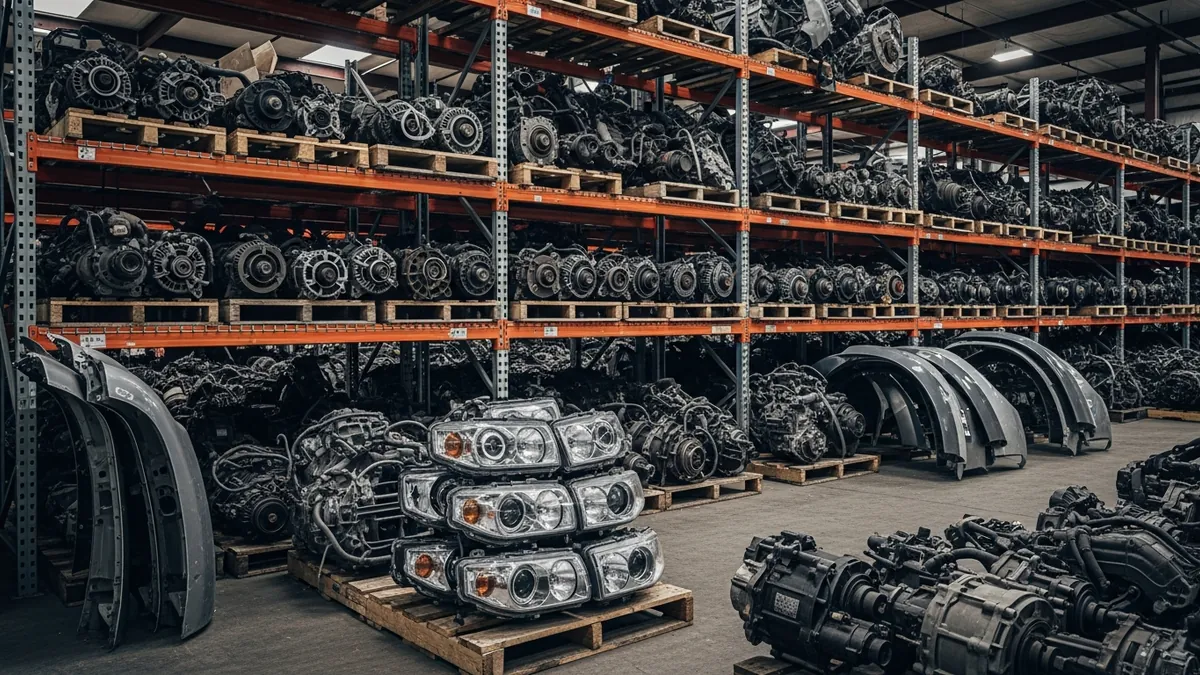
The four transmission families you will meet most
These four cover a large share of the automatic transmissions on US salvage lots. Use the table to place a unit, then qualify it by application before you pay for it.
| Family | Typical applications | What to verify beyond the name |
|---|---|---|
| GM 4L60E | Rear-drive GM trucks, SUVs, vans, and performance cars | Bellhousing pattern for your engine, 2WD vs 4WD tailshaft, removable vs non-removable bellhousing generation, case tag calibration |
| Ford 4R70W / 4R75W | Rear-drive Ford cars, trucks, and SUVs behind modular V8s | 4R70W and 4R75W are not blind swaps, torque converter stall and spline count, tailshaft length, output shaft speed sensor style |
| Chrysler 48RE | Heavy-duty Dodge Ram diesel pickups | Diesel-specific bellhousing, 2WD vs 4WD output, transfer case mating pattern, governor and valve body calibration |
| Toyota A750E | Rear-drive Toyota and Lexus trucks and SUVs | A750E vs A750F (rear-drive vs four-wheel-drive), engine bellhousing match, adapter and transfer case interface, tag calibration code |
Read that last column as a warning. Every row covers a family spanning several vehicles, and in every row the differences between those vehicles are physical. Nobody has ever been saved by two units saying the same thing on the case.
How to identify the transmission you have
The identity you need is stamped on the case itself, not on your registration. Find the tag or the stamped pad before you shop, photograph it, and carry the photo.
- Find the tag. Most units carry a metal tag riveted to the case or a stamped pad on the pan rail, bellhousing, or driver-side flat. Expect it to be caked in road grime. A wire brush and a rag make it readable.
- Record every character. Copy the full string, including the letters that look like noise. Those trailing characters are usually the calibration and build codes that separate one application from another.
- Cross-check against your VIN. Decode your own vehicle so you know the engine and drivetrain the transmission was built to live behind. Our VIN lookup tool handles this in a few seconds.
- Match the tag, not the model year. Manufacturers change calibrations mid-year without changing anything you can see from the outside. The tag is the arbiter.
- Confirm the interchange before you drive out. Car-Part.com lists 150 to 250 million parts from roughly 3,100 recyclers, which makes it a fast way to confirm which applications a given number covers.
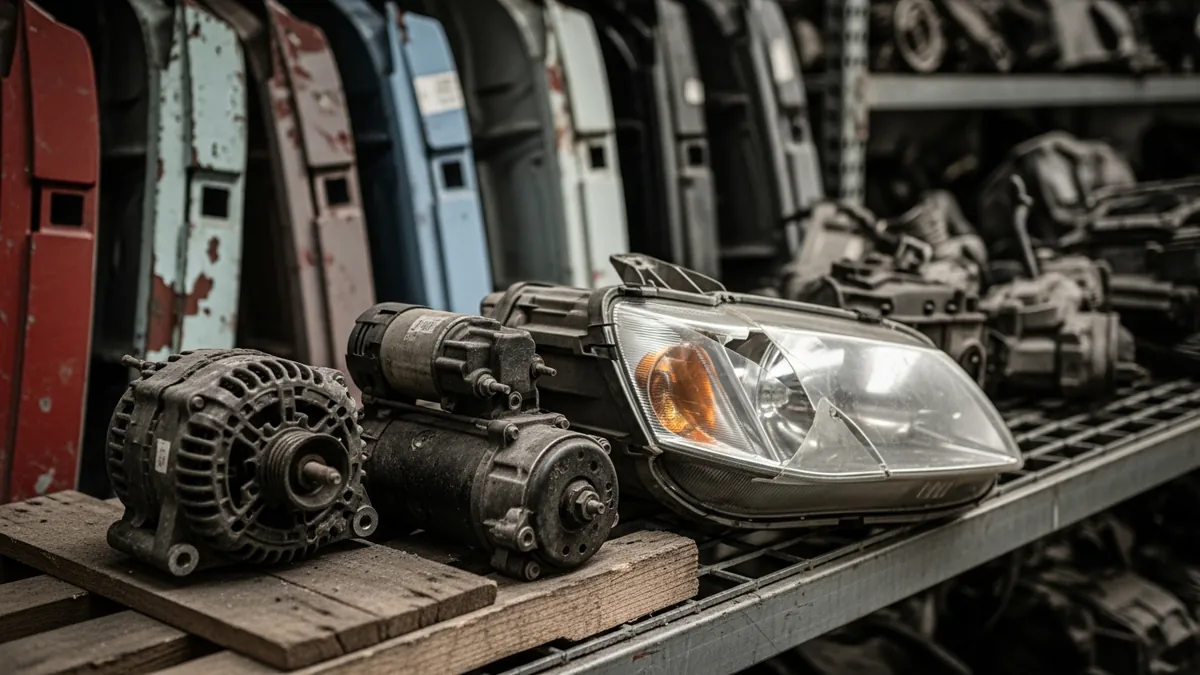
What to inspect on the unit itself
Fluid first, case second, input shaft third. That order catches the expensive problems before you spend time on the cosmetic ones.
The ATF. Pull the dipstick if the unit has one, or crack the pan drain or a cooler line fitting and catch a few drops on a white rag. Healthy automatic transmission fluid is red or pink and smells faintly sweet. Fluid that is dark brown and smells scorched means internal damage — the clutch friction material has cooked and shed, and what is left of it is sitting in the pan and moving through the valve body. Walk away. Milky or foamy ATF means the radiator cooler failed and coolant has been circulating through the transmission, which is equally final.
The case and bellhousing. Run your hand around the bellhousing perimeter and look hard at the bolt bosses. Aluminum cracks at the bosses when a car takes a hard hit or when someone drops the unit off a jack. A cracked bellhousing cannot be reliably repaired and will not hold torque. Check the pan for dents deep enough to have contacted the filter, and check the mounting ears for bends.
Input shaft play. Grip the input shaft and try to move it. Rotational play against the drum is normal. Radial wobble, or in-and-out movement beyond a fraction of an inch, points at a worn front pump bushing or a failed thrust washer. Either one means the unit comes apart before it goes in.
Everything on the outside. Confirm the transmission still has its shift linkage bracket, cooler line fittings, wiring connector, and speed sensor. Missing external hardware turns a cheap transmission into a scavenger hunt. The same inspection discipline we use on any used part from a salvage yard applies here, just with more at stake.
What has to be in writing
Two numbers belong on your invoice before you pay: the donor vehicle's mileage and its full 17-digit VIN. Mileage tells you what you are actually buying, since a transmission with 60,000 miles and one with 210,000 miles look identical sitting on a rack. The VIN is what makes a warranty claim enforceable and what lets you verify the application later if something does not line up.
A yard that records the donor VIN on the receipt can honor a claim. One that will not write it down cannot, whatever the posted policy says. Ask for the warranty term in writing at the same time, and ask whether it covers the part only or part plus labor. Ask about the core charge too — cores run 5 to 100 dollars depending on the component.
Why a full-service yard is the right call here
Buy a transmission from a full-service yard. Self-service lots run 30 to 60 percent cheaper and charge a 2 to 5 dollar entry fee in 2026, and for a mirror or an alternator that math is unbeatable, which is why those sit near the top of the tier list in our guide to the best junkyard parts to buy and which to avoid. A transmission is different. It is a heavy sealed unit you cannot bench-test, most self-service sales are final, and pulling one means working under a vehicle with a driveline and crossmember to support.
Full-service yards warranty parts 30 to 90 days, and LKQ offers 6 months. On a part that takes a full day to install, that window is the difference between a bad purchase and a bad month. Full-service staff also pull the unit with its external hardware attached, the failure mode that catches most first-time buyers.
If you do pull it yourself, use rated jack stands and never a jack alone. Most yards ban customer jacks and pre-lift their vehicles for exactly this reason. Our guide to pulling your own parts covers the rest of the safety procedure. And move quickly on any donor you have found — cars are typically crushed after 30 to 90 days on a self-service lot.
To find yards that stock drivetrain parts and quote warranty terms up front, start with our junkyard directory. The right transmission is usually within driving distance.