Junkyards That Buy Cars Near Me: How to Find and Vet One
Half the yards you call only sell parts, they do not buy cars. Here is how to tell a real dismantler from a broker, and why two honest quotes can differ by hundreds.
Key Takeaways
- Three different businesses answer the phone when you search for a junkyard that buys cars — full-service dismantlers, scrap-only shredders, and national online brokers. Their offers on the same car are not comparable.
- A shredder pays for weight. A dismantler pays for resale potential. That single difference is why two honest quotes on the same car can differ by $200-$400.
- Most junk cars sold for $250-$800 in 2026, national average near $535, with scrap running $155-$205 per ton as of July 1, 2026.
- The pickup-day rewrite is the most common scam in this business. Get the quote in writing with the VIN on it before a truck is dispatched.
Which junkyards actually buy cars?
Fewer than you would guess. A large share of the yards near you sell parts off vehicles they already own and have no interest in buying another car from the public, especially not a common model they already have four of on the lot. The Automotive Recyclers Association counts more than 9,000 auto recycling locations in the United States, and buying end-of-life vehicles from walk-in sellers is only one of several business models operating under that count.
So the first question on every call is blunt: do you buy vehicles directly from the public, or do you only sell parts? Asking it first saves you ten minutes of describing a 2009 Camry to someone who was never going to make an offer. Start by pulling a list of yards within towing range from our salvage yard directory, then work the phone.
The three buyer types and why their offers differ
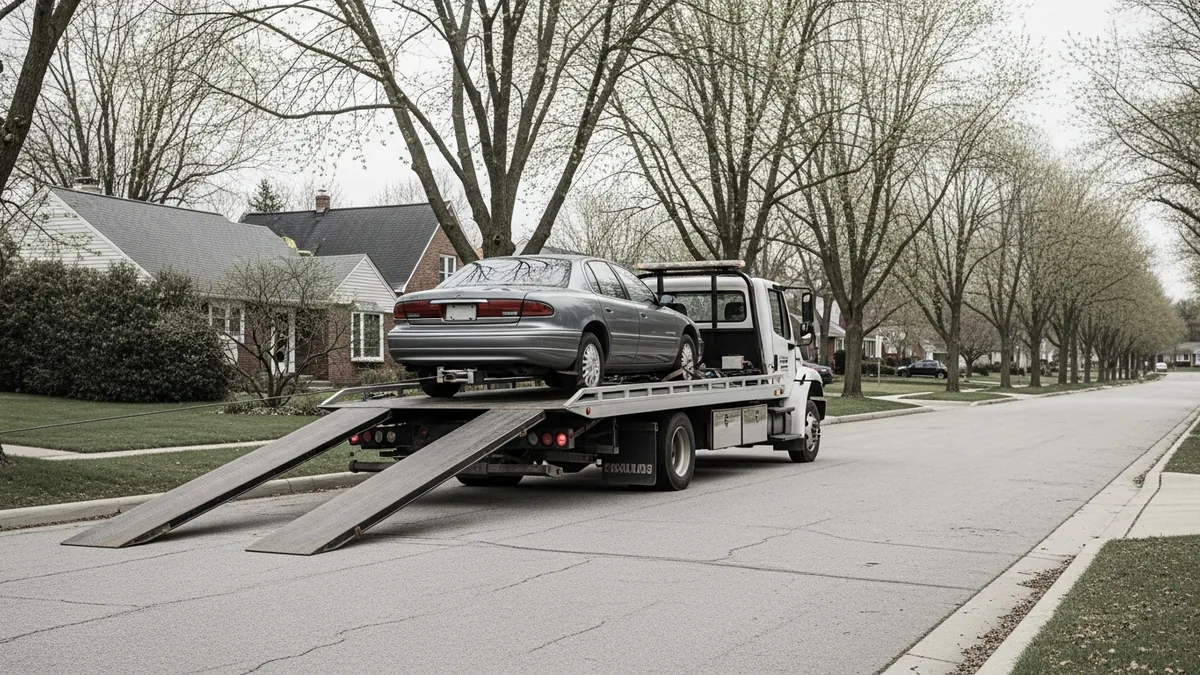
Every offer you receive comes from one of three business models, and each one values your car by a different formula. A full-service dismantler estimates what the parts will sell for. A scrap-only operation weighs the car and pays tonnage. A national online buyer quotes you a number, then finds a local yard willing to do the work for less and keeps the spread.
| Buyer type | Who it suits | Typical 2026 offer | Payment timing |
|---|---|---|---|
| Full-service dismantler | Cars with intact factory cat, running engine, good glass, or in-demand body panels | $400-$800, higher with a factory converter | Cash or company check handed over at pickup |
| Scrap-only shredder | Burned, flooded, stripped, or badly rusted cars with nothing resellable left | $250-$400, driven by weight at $155-$205 per ton | Paid on the certified scale ticket, same day |
| National online buyer or broker | Sellers in rural areas with two or fewer local yards, or anyone who values speed over price | Roughly 10-20% under a direct local quote | Check at pickup, sometimes mailed after title transfer |
Why the shredder pays less and is not cheating you
A shredder buys steel, not a car. It does not care that your alternator is six months old, because none of that survives the process. The math is tonnage times the going rate, minus tow cost, minus the roughly 500 lbs most yards subtract for tires and fluids before they pay. Towing costs the buyer $75-$150, which comes straight out of your number even when the pickup is advertised as free.
A dismantler runs a completely different spreadsheet. It is projecting what a taillight assembly, a transmission, and a factory catalytic converter will sell for over the next year. A factory converter alone adds $75-$900 depending on the vehicle, while an aftermarket unit adds $5-$20. When a dismantler quotes you $625 and a shredder quotes you $310 on the same car, neither one is lying. They are buying two different things. Our guide to what your junk car is worth in 2026 breaks down the line items in more detail.
How to tell a licensed yard from a broker
Ask two questions: are you licensed as a dismantler in this state, and what exact legal name is the license issued under? A licensed yard answers both without pausing, and the name they give will match the sign on the building or the entity behind it. A broker will give you a marketing brand, redirect to a national 800 number, or tell you a local partner handles the actual pickup.
Brokers are legal and sometimes useful, particularly if you live somewhere with only one or two yards in tow range. The problem is arithmetic: the broker's fee comes out of your offer, so you land 10-20% behind what the yard doing the work would have paid directly. If you can identify that yard, call it yourself.
The questions that separate them
- "Are you licensed in this state, and under what name?" — hesitation on the legal name is the single most reliable tell.
- "Do you own the tow truck, or do you dispatch a third party?" — a broker never owns the truck.
- "Is payment cash or company check, and does the driver have it at pickup?" — the correct answer is one of those two, in hand, before the car goes on the truck. "We mail it after we process the title" means you have no leverage once the car is gone.
- "What is your physical yard address?" — then look it up. A residential address or a mailbox store means you are talking to a middleman.
What paperwork to have ready before you call
Have the title, your photo ID, and the current registration in front of you when you dial. Yards quote faster and more accurately when you can read them the VIN, and a seller with documents ready gets treated as a serious call rather than a tire-kicker.
- Title in your name. If the name on the title does not match your ID, sort that out first — no licensed yard will complete the sale. If the title is gone entirely, selling a junk car without a title is still possible in most states, but it adds paperwork before anyone will quote you.
- Photo ID that matches. The driver will check it against the title at pickup. A mismatch cancels the sale on the spot.
- Lien release if applicable. A lien listed on the title kills the deal until the lender issues a written release.
- The VIN, written down. Run it through our VIN lookup tool first so you know the exact engine and trim you are describing.
- Notice of transfer form. Filing it is what ends your liability. In California that is the REG 138, due within 5 days of the sale.
The pickup-day rewrite scam
This is the one that costs sellers real money. A buyer quotes $600 over the phone, dispatches a truck, and then the driver walks around the car and announces a problem — the catalytic converter is missing, the tires are shot, the mileage is higher than you said. New offer: $325. Your car is already half-winched onto the flatbed and the driver knows you do not want to start over with a new set of calls.
Sometimes the finding is legitimate. A car with no converter really is worth several hundred less, and if you did not mention it, that is on you. The scam version is vague: the driver cannot point to anything specific, and the number drops far more than any missing component justifies.
Three things defeat it. Get the quote in writing by text or email with the VIN on it and the phrase "quote valid on arrival subject to condition as described." Photograph the car from all four corners plus the undercarriage the day before pickup. And be willing to say no — tell the driver to put it back down and call the next yard on your list. A buyer who quoted honestly will hold the number. A buyer running the rewrite will suddenly rediscover most of the original offer.
Getting three quotes without wasting an afternoon
Call one of each type: the nearest full-service dismantler, a scrap yard, and one online buyer. That spread tells you what your car is worth in your market inside twenty minutes of phone time. Give every buyer the same description — year, make, model, trim, mileage, whether it runs, whether the converter is present, and any missing panels — because a quote based on a different description is not a comparison.
If the highest offer still feels low, the car may be worth more in pieces, or in California more through the state's vehicle retirement buyback, which usually beats a yard quote if you qualify. A running engine or clean transmission can sell for more on its own than the whole vehicle scraps for, though you then own the problem of removing it. Our guide to pulling your own parts covers that work. When you are ready, start with a quote on your junk car.